
Home / Articles / Reinforced Concrete BA-02
Connections in Precast Buildings: The Weakest Link in the Chain
The same precast technique produced housing that came through the 2003 Bingöl earthquake undamaged and industrial buildings that collapsed on 6 February. The connection made the difference. TBDY Chapter 8 connection types, behaviour factors and the detail it forbids.
1. A two-sided record
İTÜ’s 6 February report says two opposite things about precast buildings. Among the causes of collapse it lists, for industrial buildings, missing lateral stability connections and inadequate beam–column joints (§3.14 item 7; see DEP-03). The same report notes a good record for precast systems in post-earthquake housing: the Bingöl housing with moment-resisting (MAB3) precast frames came through the 2003 earthquake undamaged, and an 8-storey building in Van made monolithic by post-tensioning (MAB2) suffered no structural damage in 2011 (p. 168).
What unites the two observations is a single word: connection. A precast building is sound factory-made members joined on site; the weakest link is usually not the members but what joins them.
2. The connection type sets the behaviour factor
TBDY 2018 Chapter 8 defines two families. Pinned connections (MFB) transfer no moment, only shear and axial force: pinned (MFB1), welded (MFB2) and slotted (MFB3). Moment-resisting connections (MAB) must transfer the forces at the capacity of the connected members without loss of strength or ductility (8.4.1.2): wet (MAB1), fully post-tensioned (MAB2), wet-top/welded-bottom (MAB3) and sleeved-pinned (MAB4).
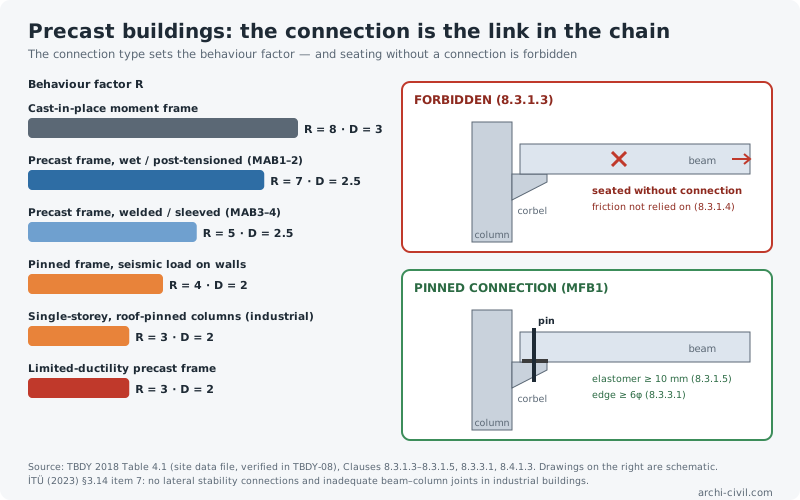
Table 4.1 ties this choice directly to the behaviour factor: a precast moment frame takes R = 7 with wet or post-tensioned connections, but R = 5 with welded or sleeved ones, and is limited to lower buildings. The typical industrial building, a single-storey system with columns pinned at the roof, has R = 3: it must carry most of the seismic force without reduction.
3. The forbidden detail
What the report calls "missing lateral stability connections" is explicitly forbidden by the code:
- Clause 8.3.1.3: in pinned connections, horizontal members may not be seated without connection on other horizontal members, columns or walls.
- Clause 8.3.1.4: friction at supports is ignored; friction cannot be relied on to keep a beam in place.
- Clause 8.3.1.8: forces in pinned connections are computed amplified by the overstrength factor D.
The details of a pinned connection are prescribed too: at least a 10 mm steel-reinforced elastomer pad where no steel plate is used (8.3.1.5); the pin hole at least 6 pin diameters from both the beam end and the free edge of the column support (8.3.3.1); hole diameter at least twice the pin diameter (8.3.3.2); d/φ > 6 in the shear calculation (8.3.3.7). In slotted connections the slot cheeks are at least 15 cm thick and reinforced for 1.2 times the overturning moment (8.3.5).
4. Stricter general rules
- The minimum concrete class is C30 (8.2.3.2); for cast-in-place members resisting earthquakes the lower limit is C25.
- In high-seismicity zones (DTS 1a, 2a), for precast buildings of BYS 2–3, strength-based design with I = 1.5 is only a preliminary design; the building is further assessed by deformation for Controlled Damage under DD-1 and Limited Damage under DD-3 (8.2.2.3).
- An undefined connection type may be used only if tests show adequate stiffness, strength and ductility, stable hysteresis and energy dissipation equivalent to a monolithic connection (8.2.1.3).
5. Lessons
- Precast is not the problem; the connection is. The same technique produced undamaged buildings with the right connection and collapses with the wrong one.
- No member simply "sits". Every beam is tied to its support by a pin, weld or slot.
- The ductility of the connection sets R. Choosing a less ductile connection means a larger seismic force.
- An industrial building is a structure too. Single-storey pinned systems are designed with R = 3; they leave very little of the seismic force to ductility.
References
- TBDY 2018 — Chapter 8 (Precast reinforced concrete buildings): 8.2.1.3, 8.2.2.3, 8.2.3.2, 8.3.1.3–8.3.1.8, 8.3.3.1–8.3.3.7, 8.3.5, 8.4.1.2–8.4.1.3; Table 4.1 (site data file data/code-packs/TR/tbdy2018-systems.json). Official text.
- İTÜ (2023). Report on the 6 February 2023 Kahramanmaraş Earthquakes (in Turkish) — §3.14 item 7 (pp. 139–140), §4.2.3 Precast reinforced concrete housing (p. 168).
The numbers in this article were produced by the site's engines; code values are given with their clause numbers.