
Home / Articles / Earthquake Lessons DEP-01
6 February 2023: When Records Exceed the Design Spectrum
At a station in Hatay the records exceeded TBDY’s 2475-year “maximum considered” spectrum by 33–64%; at another station they reached almost twice it at 1–2 s. Ordinary new buildings, however, are designed not to this level but to the 475-year level. What does this mean, and what does it not mean?
Note: This article is written with respect for the tens of thousands of people who lost their lives in the earthquakes of 6 February 2023, to present the facts from their source. All figures come from İTÜ's February 2023 earthquake report and the official text of TBDY 2018.
1. One number: +64%
İTÜ's report compared the records of the five AFAD stations that recorded the largest ground accelerations in the affected provinces (3129, 3123, 2712, 4615, 8002) with the TBDY 2018 design spectrum. The geometric mean of the 5%-damped response spectra of the two horizontal components was compared with the DD-1 horizontal elastic design spectrum defined for soil class ZC. At station 3129 in Hatay:
2. Five stations: where, and at which period?
The report's text mentions only 3129; but Figure 2.13 gives the percentages of all five stations at four periods. Converted to record/design ratios, a different picture emerges:
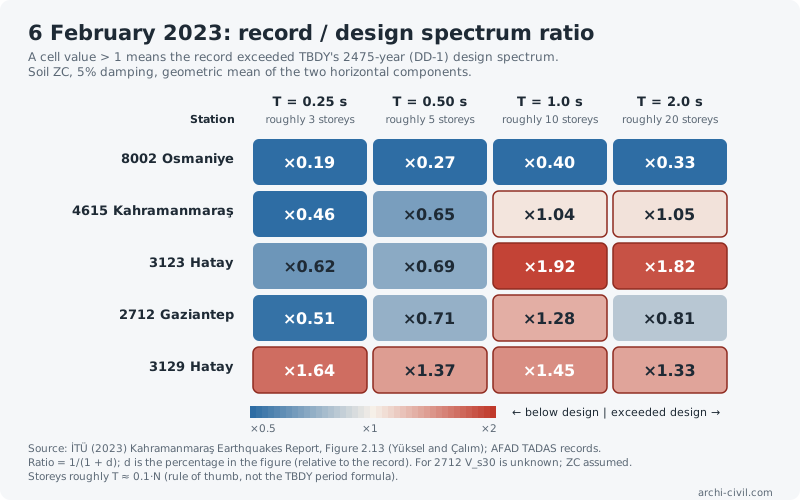
At station 3123 in Hatay the record is about twice the design spectrum at 1 and 2 seconds (×1.92 and ×1.82). Long periods correspond to taller buildings: as a rough rule, 1 s is about a 10-storey and 2 s about a 20-storey building. In Kahramanmaraş and Gaziantep the design value was also exceeded at long periods. In Osmaniye, by contrast, the records stayed far below the design spectrum. This shows how different the demands of the same earthquake can be depending on place, soil and period.
3. What is DD-1?
TBDY 2018 defines four earthquake ground-motion levels. DD-1 is "a very rare ground motion with a 2% probability of exceedance in 50 years and a return period of 2475 years"; the code also calls it the "maximum considered earthquake ground motion" (Clause 2.2.1).
The critical detail of the ladder is in Table 3.4(a): new non-tall buildings (BYS ≥ 2), under the normal performance objective, are designed by strength for "Controlled Damage" at DD-2 (475 years) only. "Collapse Prevention" under DD-1 is a normal objective only for tall buildings (BYS = 1). So the records in Hatay exceeded even the 2475-year level, far above the level to which an ordinary building is designed.
4. Comparison with past earthquakes
The report also compares acceleration records of major earthquakes in Turkey since 1990 (Figures 2.14–2.15). The peak horizontal ground acceleration of the 6 February Kahramanmaraş earthquake was 3.5 times that of the 1999 Kocaeli earthquake; the peak vertical ground acceleration 4.3 times. On 6 February there were the Pazarcık (Mw 7.7, 04:17), Nurdağı (Mw 6.6, 04:28) and Elbistan (Mw 7.6, 13:24) earthquakes, and on 20 February the Defne earthquake (Mw 6.4).
5. Does exceedance mean the code is wrong?
No, but it is a warning to be read carefully. A design spectrum is not a ceiling but a probability: "2% in 50 years" means it is expected to be exceeded, however rarely — especially right next to the fault, where directivity and local soil effects accumulate. What an exceedance means for a structure depends on its design level: when the spectral demand exceeds the design value, the building's ductility and overstrength come into play. That is why the code requires not only strength but ductility (R and D factors, ductile detailing) and storey-drift limits.
6. Points to watch when reading
- Soil assumption: the stations' Vs30 values correspond to class ZC; but for station 2712 no Vs30 was available and its soil class was assumed to be ZC.
- Geometric mean: the comparison uses the geometric mean of the two horizontal components; a single component can be larger than the mean.
- Published numbers: this article uses only the ratios the report gives in its text. The other stations' differences appear as an image in the report's Figure 2.13.
7. Lessons for the engineer
- A design spectrum is a floor, not a ceiling. Detailing (ductility) matters no less than the design force.
- The code's "ductile" assumptions hold only when they are built: confinement, strong-column–weak-beam and irregularity limits are what keep a building standing when the spectrum is exceeded.
- For important buildings, think one level up. TBDY imposes stricter rules on schools and hospitals (BKS 1); 6 February showed why.
References
- İTÜ (2023). Report on the 6 February 2023 Kahramanmaraş Earthquakes (in Turkish), Istanbul Technical University — Chapter 2 (Yüksel E., Çalım F.: Evaluation of Strong Ground Motions), §2.6 p. 64 and p. 66. Records: AFAD TADAS.
- TBDY 2018 — Clause 2.2 (DD-1…DD-4), Table 3.4 (performance objectives). Official text.
The numbers in this article were produced by the site's engines; code values are given with their clause numbers.