
Home / Articles / Earthquake Lessons DEP-04
Hospitals: A Standing Hospital Is Not a Working Hospital
On 6 February some hospitals collapsed; in others whose structure stood, falling ceilings, cracking walls and leaking pipes stopped them working. İTÜ’s observations, TBDY’s counterparts and the stricter U.S. rules for critical healthcare facilities.
1. The building most needed after an earthquake
After an earthquake the injured go first to the hospital. TBDY 2018 therefore lists hospitals, dispensaries and health centres among the buildings that must be usable immediately after an earthquake: Building Importance Class 1, importance factor I = 1.5 (Table 3.1). But 6 February made one thing plain: a hospital that stands is not necessarily a hospital that works.
2. Hospitals on 6 February: two faces
At the request of hospital authorities, İTÜ teams carried out rapid preliminary inspections of hospitals right after the earthquakes (§3.3). The report’s observations draw two separate pictures:
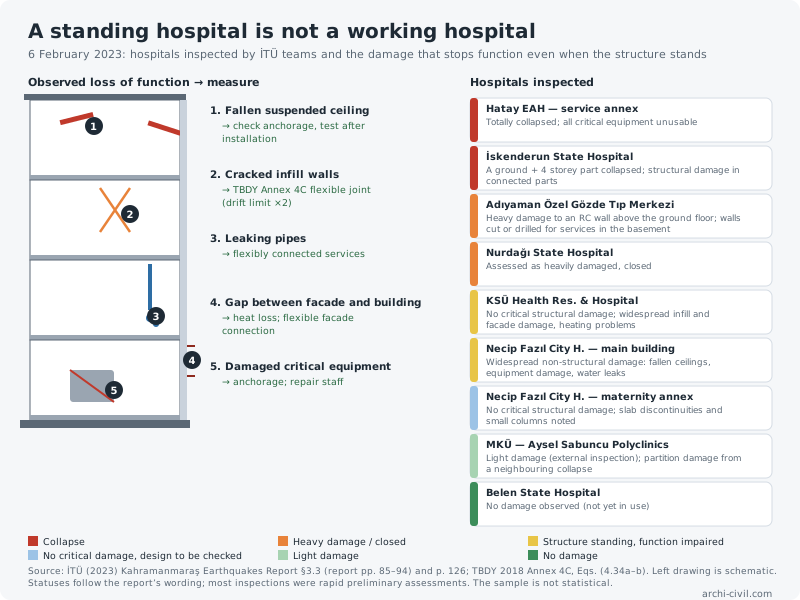
- Loss of the structure: the service annex of Hatay Training and Research Hospital collapsed completely and all its critical equipment became unusable; a ground-plus-four-storey part of İskenderun State Hospital collapsed; Nurdağı State Hospital was assessed as heavily damaged and closed. In a private hospital in Adıyaman an RC wall was heavily damaged, and in the basement walls had been cut or drilled to pass pipes and ducts.
- Structure standing, function lost: in two large hospitals in Kahramanmaraş no critical structural damage was observed; but infill walls were widely damaged, suspended ceilings fell (the report notes it is very likely they injured staff and patients, and that they badly damaged critical equipment), water pipes leaked, and gaps opening between facade and building kept some rooms from being heated.
3. Counterparts in the codes
Infill walls: where infills act with the frame, TBDY limits storey drift to λ·δ/h ≤ 0.008κ (Eq. 4.34a). If infills are separated from columns by flexible joints, the limit doubles to 0.016κ (Eq. 4.34b), provided tests document that the jointed wall can take that drift. Annex 4C gives an example detail: a C-profile anchored to the inner faces of columns and walls lets the wall move in plane while keeping it from toppling out of plane. İTÜ recommends this detail for hospitals.
Irregularities: for a weak-storey irregularity TBDY reduces the behaviour factor when the strength ratio is between 0.60 and 0.80, and never allows it below 0.60 (Clause 3.6.2.3). The U.S. Department of Defense goes further for critical healthcare facilities: in seismic design categories D–F it does not permit hospitals with extreme torsional, extreme soft-storey or weak-storey irregularities; it bans lightweight concrete in seismic-force-resisting members; and it accepts seismic isolation and damping with written approval by the authority having jurisdiction (UFC 3-301-01 Chapter 7). In Chapter 6 it adopts the hospital chapters of the California Building Code, the strictest in the United States on hospital seismic safety.
Source note: the edition of UFC 3-301-01 used is 11 April 2023, Change 6 (January 2026); its cover carries a CANCELLED watermark. The counterparts of Chapters 6 and 7 in the July 2026 edition are not yet verified on the site.
4. İTÜ’s recommendations
- Infill walls in hospitals should follow the flexible connection detail of TBDY Annex 4C.
- Suspended ceiling connections should be carefully checked and tested after installation.
- Relief teams sent to an earthquake zone should include technical staff able to repair electrical, heating, lift and water systems.
- Structural drawings should be kept where technical staff can reach them quickly after an earthquake; only then can damage in large enclosed buildings be assessed quickly and correctly.
5. Lessons
- For a hospital the goal is not to stand but to work. Non-structural elements decide function as much as the structure.
- Treat the ceiling like a structural element. A falling ceiling injures both people and equipment.
- Walls are not drilled. A shear wall cut for services is no longer the wall in the design.
- In a hospital an irregularity is not a risk but an error. The strictest approaches forbid it outright in critical facilities.
References
- İTÜ (2023). Report on the 6 February 2023 Kahramanmaraş Earthquakes (in Turkish) — §3.3 Damage observed in hospital buildings (pp. 85–94), p. 126; recommendations p. 94.
- TBDY 2018 — Table 3.1 (BKS 1), Clause 3.6.2.3, Eqs. (4.34a–b), Informative Annex 4C. Official text.
- U.S. DoD. UFC 3-301-01, 11 April 2023, Change 6 (30 January 2026; cover marked CANCELLED) — Chapter 6 (IBC modifications, critical healthcare) and Chapter 7 (ASCE 7-16 modifications).
- archi-civil.com data file data/reports/itu-2023-hospitals.json — 9 hospitals and page references (v616).
The numbers in this article were produced by the site's engines; code values are given with their clause numbers.