
Home / Articles / Earthquake Lessons DEP-02
School Buildings and 6 February: What Stood, What Fell, and the Lessons
Among 18 schools inspected by İTÜ teams, the structural systems of post-2000 RC buildings stood; the damage was in stairs, added roof storeys and walls. The only collapse was not a school building but a kindergarten in a housing block.
Note: This article presents the observations on school buildings in İTÜ's February 2023 earthquake report. For the code rule itself see TBDY-08; for a step-by-step seismic calculation of a school, the three-storey school example (in Turkish).
1. Why is a school a different building?
TBDY 2018 places schools, other educational buildings and dormitories in Building Importance Class 1 (BKS 1) with an importance factor I = 1.5; for housing it is 1.0 (Table 3.1). The reason is plain: they hold many children and often become shelters and gathering places after an earthquake. The code also forbids limited-ductility structural systems in BKS 1 buildings (Clause 4.3.4.1(a); see TBDY-08).
2. What did the teams inspect?
İTÜ teams inspected school buildings in Adıyaman (Çelikhan, Tut, Pınarbaşı) and Hatay (Antakya, Defne, Kırıkhan, Belen) (§3.2, pp. 77–86; §3.7, pp. 123–128). Here the 18 schools named in the report are grouped into five classes according to the report's own wording:
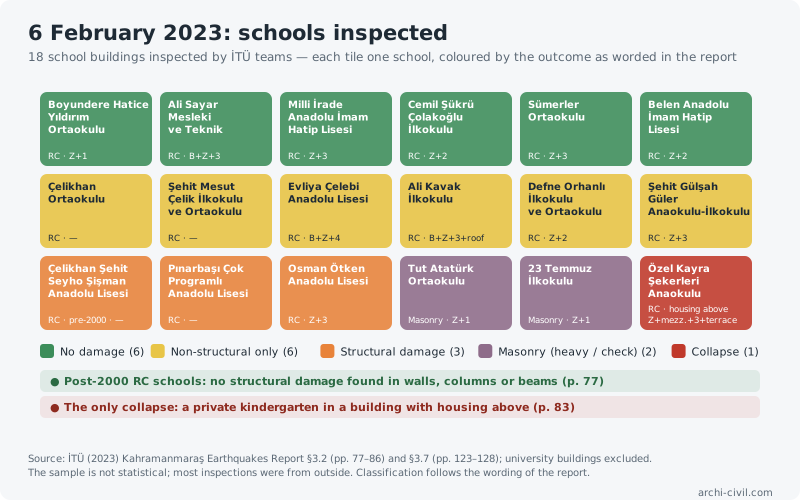
This is a sample, not a statistic: the schools were not chosen at random and most inspections were from outside. Even so, the report itself makes a clear general observation.
3. Schools that stood: post-2000 reinforced concrete
The key sentence of the Adıyaman section is this: in reinforced concrete school buildings built in the 2000s and designed to the 1997 or 2007 seismic codes, no structural damage was found in walls, columns or beams (p. 77). In Hatay, Belen Anadolu İmam Hatip Lisesi, completed in 2019, showed no cracks or structural damage either (p. 128).
The three RC schools with structural damage: a pre-2000 high school with diagonal shear cracks at beam and column ends (moderate damage), another with cracks at beam ends and settlement, and a high school in Antakya with buckled reinforcement at column bases.
4. If the structure is undamaged, is the school safe?
In six schools the damage was in non-structural elements only; that does not make it minor. The report's observations are in places that bear directly on children's life safety:
- Stairs: some schools had damage requiring repair at the joint between stair flight and landing slab; entrance stairs showed settlement and breakage. A stair is an escape route.
- Added roof storeys: in one school the infill walls of a steel roof storey added later fell into the schoolyard; in another all roof-storey infills collapsed.
- Facade and garden walls: in one high school most exterior partitions and the roof collapsed; in several schools garden walls fell.
For children leaving the building and gathering in the yard, a falling wall matters as much as a standing structure.
5. The only collapse was not a school building
The only total collapse among the inspected schools was a private kindergarten in Antakya. It occupied the ground and mezzanine floors; the floors above were housing. The report notes windows instead of walls on the front of the kindergarten floors, the mezzanine, a collapse attributed to a weak/soft storey, and missing longitudinal reinforcement and stirrups at beam–column joints (p. 83).
The question that follows matters: can a kindergarten sit in a building designed as housing rather than to the importance and ductility the code requires for schools? The report does not say to which code or importance class this building was designed; but when the use changes, so does the importance the building must carry.
6. Masonry schools
One of the two masonry schools inspected was rated heavily damaged even though its walls were undamaged: there was no rigid diaphragm at the ground-floor ceiling and roof level, and no bond beam tying the walls together; it had also reached the end of its service life (p. 81). In a masonry building the floor and bond beam that make walls act together matter as much as the walls themselves.
7. Lessons
- The code works when it is applied: the absence of structural damage in post-2000 RC schools is the field evidence of that era's codes.
- Treat escape routes like structural members: stair flight–landing joints and entrance stairs deserve separate checks.
- Question everything added later: roof-storey additions and infills are not in the building's design.
- A change of use is a structural decision: a kindergarten moving into a housing block does not bring school importance to the building.
- The yard is part of the school: walls and facades that can fall onto the gathering area need their own assessment.
References
- İTÜ (2023). Report on the 6 February 2023 Kahramanmaraş Earthquakes (in Turkish), Istanbul Technical University — §3.2 Damage observed in school buildings (pp. 77–86), §3.7 Undamaged buildings (pp. 123–128).
- TBDY 2018 — Table 3.1 (Building importance classes and factors), Clause 4.3.4.1(a). Official text.
- archi-civil.com data file data/reports/itu-2023-schools.json — classification and page references of the 18 schools (v608).
The numbers in this article were produced by the site's engines; code values are given with their clause numbers.