
Home / Articles / Building Materials MLZ-04
Reinforcing Steel: Not Strength, but Ductility
Many fractured bars were found in buildings that collapsed on 6 February. TBDY asks of a bar not only strength but elongation before rupture, and bounds the strength ratio from both sides. Table 5A.1, Eq. (5A.7) and what we found in the site’s engines.
1. Fractured bars
İTÜ’s 6 February report lists the quality of reinforcing steel as a separate cause of collapse: the steel used did not have the properties required by the code, and many fractured longitudinal and transverse bars were found in damaged members (see DEP-03). A bar that ruptures in an earthquake means the collapse of every ductility assumption of reinforced concrete.
2. Three phases of a bar
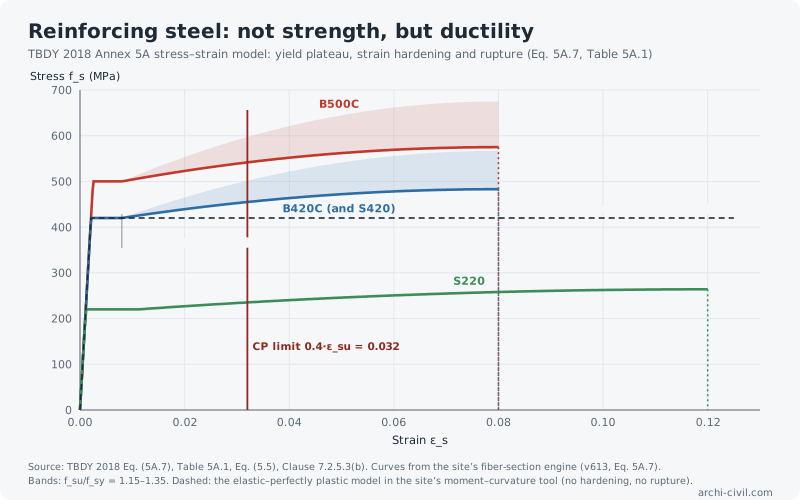
For nonlinear assessment TBDY 2018 defines a three-branch model for reinforcing steel (Annex 5A, Eq. 5A.7): an elastic branch (Es = 200,000 MPa), a yield plateau at constant yield stress, and strain hardening in which stress rises along a quadratic curve to the tensile strength. The strain at the end of hardening is rupture.
| Grade | fsy (MPa) | εsy | εsh | εsu | fsu/fsy |
|---|---|---|---|---|---|
| S220 | 220 | 0.0011 | 0.011 | 0.12 | 1.20 |
| S420 | 420 | 0.0021 | 0.008 | 0.08 | 1.15–1.35 |
| B420C | 420 | 0.0021 | 0.008 | 0.08 | 1.15–1.35 |
| B500C | 500 | 0.0025 | 0.008 | 0.08 | 1.15–1.35 |
The table gives the values of TBDY Table 5A.1. The rupture strain is roughly 30–40 times the yield strain for B420C and B500C, and more than 100 times for S220: a bar’s real value lies in how far it can stretch after yielding.
3. Why a two-sided limit?
The ratio fsu/fsy in the table is bounded from below (1.15) and from above (1.35). The engineering rationale of the two bounds can be explained as follows:
- Lower bound: if strength does not rise enough after yielding, plastic strain concentrates at a single section; hardening spreads plasticity along a length of the member and increases rotation capacity.
- Upper bound: if the steel’s actual strength is far above the design value, capacity design breaks down: the beam turns out stronger than expected and transfers more force to the column and to shear than calculated. The strong-column–weak-beam principle also requires the steel not to be "too strong".
TBDY therefore requires the ribbed steels B420C and B500C of TS 708 in members resisting earthquake effects; S420 may be used only if its tensile/yield strength ratio is below 1.35 and its carbon equivalent does not exceed 0.55% (Clause 7.2.5.3(b)).
4. The collapse-prevention limit: far short of rupture
In deformation-based assessment TBDY limits the steel strain for the Collapse Prevention performance level to εs(CP) = 0.4·εsu (Eq. 5.5). For B420C and B500C this is 0.032: 40% of rupture. The margin covers cyclic loading, buckling and material uncertainty.
5. What we found in the site’s engines
While preparing this article we compared the site’s engines with this model:
- The εsu values in the existing-building assessment engine match Table 5A.1.
- The moment–curvature (fiber section) engine models reinforcement as elastic–perfectly plastic; there is no hardening or rupture, and failure is defined by concrete crushing. At typical reinforcement ratios this does not exceed the rupture limit (steel strain at failure 1.3–5%). In lightly reinforced sections, however, the steel passes the CP limit before the concrete crushes: in a 300×500 mm section with ρ = 0.22%, εs = 0.050 > 0.032 at failure. The engine now issues a warning in this case; the TBDY Eq. (5A.7) model was also added as a separate function (the curves in Figure 87 are drawn with it).
6. Rules
- The grade describes ductility more than strength. The letter "C" is a guarantee of elongation before rupture.
- Material is not an assumption but a matter of inspection. The certificate and testing of steel on site matter as much as the calculation.
- Too-strong steel is a problem too. Capacity design relies on the material’s upper bound as well.
- In lightly reinforced sections, check the steel too. There, the reinforcement rather than the concrete may govern failure.
References
- TBDY 2018 — Annex 5A, Eq. (5A.7) and Table 5A.1 (reinforcing steel model); Eq. (5.5) (εs(CP) = 0.4εsu); Clause 7.2.5.3(b) (B420C, B500C; conditions for S420). Official text.
- İTÜ (2023). Report on the 6 February 2023 Kahramanmaraş Earthquakes (in Turkish), §3.14 item 4 (pp. 139–140).
- archi-civil.com engine/fiber-section.js (v613: steelStressTBDY5A, steel-limit warning) and engine/tbdy-assessment.js — tests/v613-mlz04.test.js.
The numbers in this article were produced by the site's engines; code values are given with their clause numbers.