
Home / Articles / TBDY 2018 MEV-01
Assessing Existing Buildings: One Question, Two Codes
Assessing an existing building differs from designing a new one: first you must find out what is there. How do TBDY 2018 and the U.S. Department of Defense answer the questions of when, to which objective, and with how much knowledge?
1. Why is an existing building a different question?
When designing a new building, materials and details are in the engineer’s hands; for an existing building one must first find out what is there. TBDY 2018 states this difference with two rules: member capacities of existing buildings are computed with existing material strengths and, unless stated otherwise, are not divided by the material factors of the design codes (§15.2.12(b)); in return, capacities are multiplied by a knowledge factor that depends on how much information was gathered (Table 15.1).
2. When is a building assessed?
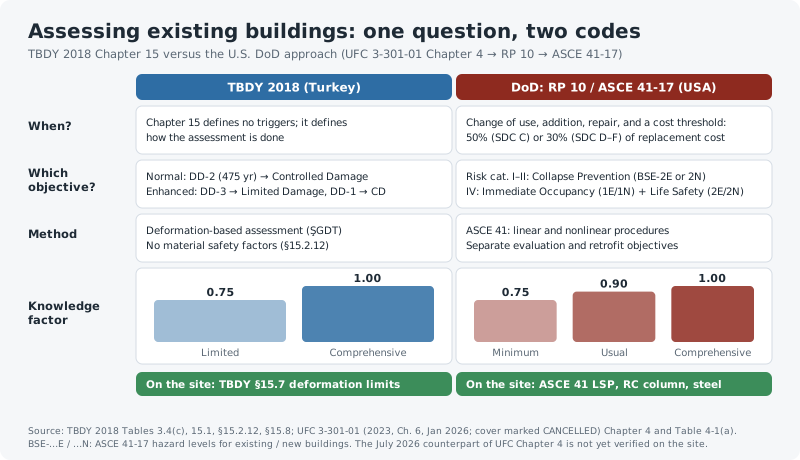
This is the most instructive difference between the two approaches. The U.S. Department of Defense adopts the federal standard RP 10 and lists the circumstances that make a seismic evaluation of an existing building mandatory: change of occupancy, addition, alteration, repair of substantial structural damage, acquisition, lease, relocation. If the cost of a repair or alteration exceeds 50% of the building’s replacement cost in SDC C, or 30% in SDC D–F, evaluation is mandatory (UFC 3-301-01 §4-2.1).
TBDY 2018 Chapter 15 defines how the assessment is done; no cost-based trigger appears in that chapter (by text search). When an assessment is required is a matter for other regulations.
The "repair of substantial structural damage" item links directly to the first cause of collapse in DEP-03: some buildings moderately damaged in the first 6 February earthquake collapsed in the second.
3. Which objective?
TBDY 2018 (Table 3.4(c)): for existing non-tall buildings the normal objective is Controlled Damage under the DD-2 (475-year) earthquake; the enhanced objective asks for Limited Damage under DD-3 and Controlled Damage under DD-1. Assessment is deformation-based.
DoD (Table 4-1(a)): the objective depends on the risk category and on what triggered the evaluation. For evaluation of a risk category I–II building the objective is a single performance level: Collapse Prevention, in BSE-2E or BSE-2N depending on the trigger (the new-building level for change of occupancy, addition and relocation). For risk category IV (critical facilities) Immediate Occupancy (BSE-1E/1N) together with Life Safety (BSE-2E/2N). In ASCE 41-17, levels ending in “E” are hazard levels for existing buildings and those ending in “N” for new buildings.
A notable feature of the DoD table is that it separates evaluation from retrofit objectives: a building that meets Collapse Prevention in evaluation may be acceptable; but if it is retrofitted it must be brought to a higher objective (for I–II, for example, Life Safety in BSE-1E).
4. How much knowledge?
TBDY defines two knowledge levels: limited (0.75) and comprehensive (1.00). ASCE 41 uses three: 0.75, 0.90 and 1.00. The message is the same in both: the less you know a building, the less you can rely on it; an assessment with limited knowledge reduces member capacities by 25%.
5. On the site
- TBDY 2018 §15.7: deformation limits of existing RC members
- ASCE 41 linear static procedure (knowledge factor κ = 0.75 / 0.90 / 1.00)
- ASCE 41 RC column and steel member tools
6. Lessons
- Knowledge first, calculation second. The knowledge level changes the result itself by up to 25%.
- Evaluation and retrofit need not share one objective. DoD separates them explicitly.
- "When?" is an engineering question too. Cost thresholds turn an alteration into an opportunity to address seismic safety.
- A damaged building needs a new assessment. The capacity left after the first earthquake governs in the second.
References
- TBDY 2018 — Table 3.4(c), §15.2.12 and Table 15.1 (knowledge factors), §15.8 (seismic performance of existing buildings). Official text.
- U.S. DoD. UFC 3-301-01 Structural Engineering, 11 April 2023, Change 6 (30 January 2026; cover marked CANCELLED) — Chapter 4: §4-1 (RP 10 and 2024 IEBC), §4-2.1 (triggers), Table 4-1(a) (structural performance objectives).
- ICSSC RP 10, Standards of Seismic Safety for Existing Federally Owned and Leased Buildings; ASCE 41-17, Seismic Evaluation and Retrofit of Existing Buildings (via UFC 3-301-01).
The numbers in this article were produced by the site's engines; code values are given with their clause numbers.