
Home / Articles / Protective Structures PRT-09
Blast-Resistant Glazing — and a Clue in the Source’s Own Table
Glass is the material that injures most in a blast. UFC 3-340-02 accepts only fully tempered glass and requires it to survive. Its own table also exposes a modulus error in its text.
1. The material that injures most in a blast
Even if a building’s structure survives a blast, breaking glass can injure the people inside. UFC 3-340-02 therefore treats glazing as a separate, serious topic (§6-27–6-32) and states the design goal plainly: although tempered glass breaks into small fragments, the fragments can still be seriously hazardous, so blast-resistant glazing should be designed to survive the expected loads.
2. Which glass?
- Annealed (ordinary) glass is not recommended. Its strength is low and variable; it breaks into dagger-shaped, razor-sharp fragments.
- Design is restricted to fully tempered glass in fixed, non-openable frames; the glass must meet both DD-G-1403B and the fragment requirements of ANSI Z97.1.
- The design stress is fun = 16,000 psi, corresponding to a probability of failure of at most 0.001.
- The frame must develop the static design strength of the pane: its deflection may not exceed 1/264 of the span or 1/8 inch, and its stress fm/1.65. Otherwise frame bending raises the stresses in the glass and the pane fails below the predicted pressure.
The site’s UFC 4-010-01 glazing tool answers a different question: under the minimum antiterrorism standards, glazing meeting certain conditions is not designed for blast, only checked for compliance. UFC 3-340-02 describes how glazing is designed for blast.
3. A clue in the source’s own table
Describing its analysis model, the source gives Poisson’s ratio of tempered glass as 0.22 and its elastic modulus as "E = 1 × 10⁶ psi" (§6-29.3; confirmed on a page rendering). But the modulus of glass is about 70 GPa, i.e. about 10 × 106 psi; 1 × 10⁶ psi is ten times too low for glass.
We tested this not only against general knowledge but against the source’s own data. Table 6-11 gives the natural periods of square tempered panes. We computed the classical period of a plate simply supported on four edges with both moduli and compared it with all 294 cells of the table:
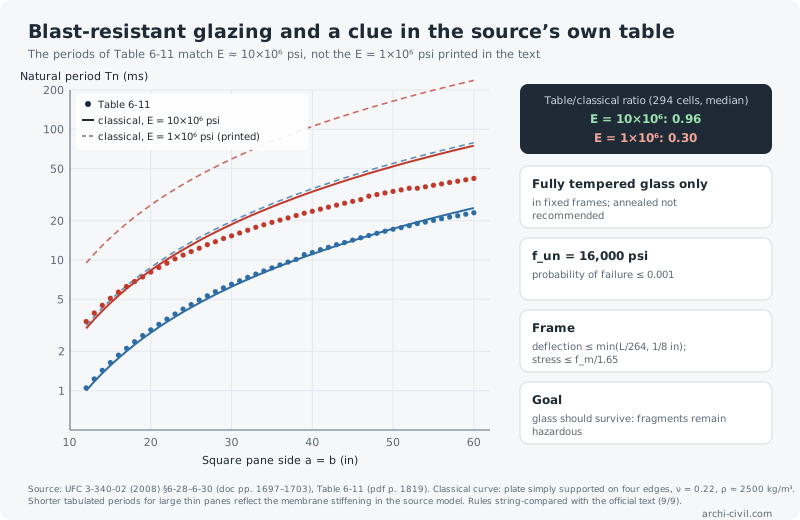
The median table/classical ratio is 0.96 with E = 10 × 106 psi and 0.30 with the printed E = 1 × 10⁶ psi (the expected 1/√10 ≈ 0.32). The table was produced with the correct modulus; the "1 × 106" in the text is a typesetting error. The shorter tabulated periods for thin, large panes make sense too: the source model includes membrane stiffening at large deflections, which the classical linear formula does not.
4. A lesson in method
When a number in a manual looks suspicious, the most reliable way to correct it is to find other data in the same source produced with that number. Here the table exposed the error in the text by itself. Earlier audits on this site found similar defects in sources: the typesetting of UFC 3-340-02 Table 5-1 and the Eq. 5-3 contradiction for A514 (PRT-07), a clause number in TS 500 (BA-01).
5. Rules
- Do not use annealed glass. Blast-resistant windows use fully tempered glass.
- Design the glass not to break. Fragments of tempered glass are hazardous too.
- The frame must not be weaker than the glass. The L/264 and 1/8 inch limits protect the pane’s strength.
- Test the source against its own data. A suspicious number can be checked against a table produced with it.
References
- U.S. DoD (2008). UFC 3-340-02: Structures to Resist the Effects of Accidental Explosions — Chapter 6: §6-27–6-32 (glazing; doc pp. 1697–1703), Table 6-11 (pdf p. 1819).
- archi-civil.com data/code-packs/US/ufc-3-340-02-ch6-glazing.json (rules 9/9 string-compared; Table 6-11 machine-parsed; E check) — tests/v622-prt09.test.js.
The numbers in this article were produced by the site's engines; code values are given with their clause numbers.