
Home / Articles / Protective Structures PRT-05
Disproportionate Collapse: What If a Column Is Lost?
Can a single column destroyed by an explosion bring down a whole building? The U.S. DoD manages this with a risk matrix and inspects collapse-resistant elements like a seismic system. ASCE 76-23, UFC 3-301-01 and the 2026 reform.
1. Small damage, large collapse
A column or wall can be lost to an explosion, an impact or a design error. The real question is what follows: does the load find another path to the ground, or does the collapse spread to neighbouring elements and reach a size disproportionate to the initiating damage? The second case is called disproportionate collapse. Its emblem in engineering history is the 1968 gas explosion in London that brought down a corner of the 22-storey Ronan Point tower.
The U.S. Department of Defense (DoD) manages this risk with ASCE 76-23 and adapts the standard to its own buildings in Chapter 7 of UFC 3-301-01 (Chapter 8 in the superseded edition).
2. How much mitigation for which building?
The required level of mitigation is set by a Collapse Resistant Design Category (CRDC). DoD ties it to three things: the building's risk category, the number of inhabited stories, and whether the building is inside a controlled perimeter (Table 7-1; Table 8-1 in the superseded edition):
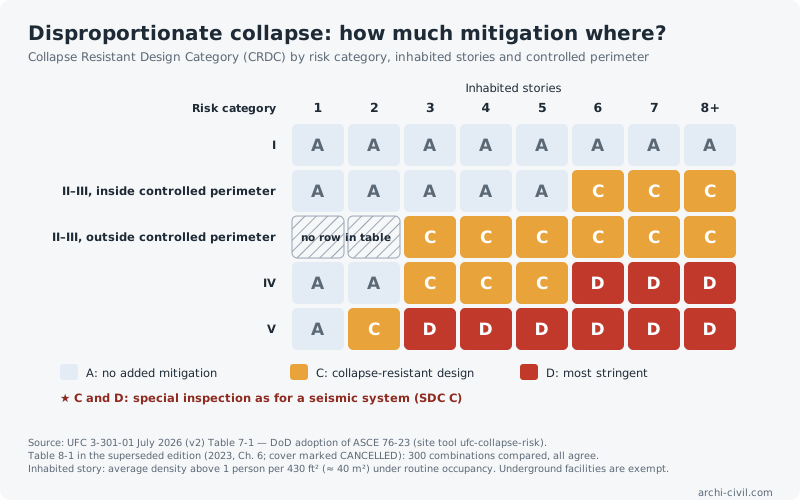
The logic of the matrix is clear: mitigation grows with occupancy and importance; a controlled perimeter, which lowers the likelihood of attack, raises the threshold. Two details are notable:
- "Inhabited story": a story whose average density under routine occupancy exceeds 1 person per 430 ft² (≈ 40 m²). This is the same 430 ft² as in UFC 4-010-01's definition of an inhabited building.
- Underground facilities are exempt, since they are "protected in other ways" (note 3). Basements of above-ground buildings are not underground facilities.
- A gap: the table has no row for risk category II–III buildings outside a controlled perimeter with fewer than 3 stories.
3. A bridge to earthquake engineering
In every structure other than CRDC A, the primary elements undergo special inspection, carried out "as if they were part of the seismic force-resisting system for a structure assigned to Seismic Design Category C" (§8-1.1 in the superseded edition). UFC's own rationale is also the main idea of this article: most collapse-resistant construction must achieve moderate or high ductility, comparable to seismic force-resisting systems.
So a building that loses a column and a building caught by a large earthquake need the same thing: a ductile, continuous structural system that can redirect load along other paths. Continuity of beams, slabs and connections saves lives here just as in earthquakes.
4. What changed in 2026?
- ECB 2026-13 (USACE, 18 June 2026): the UFC reform removed "progressive collapse mitigation requirements for installations with a fully controlled perimeter". The 25 core UFCs shrank from 2685 to 744 pages and took effect on 1 July 2026.
- ECB 2026-7 (February 2026): a bulletin clarifying policy and guidance on disproportionate collapse; we could not access its text.
- July 2026 digital edition (v2): the rules moved to Chapter 7; the 10 rows of the risk matrix are unchanged. There are three differences: the risk category IV rows now reference Note 1 only (the air-traffic-control-tower note is left unreferenced in the table); the "high value target" definition was rewritten; the sentence requiring concurrence with the Project Proponent and the AHJ is no longer in the text.
- A tension we could not resolve: ECB 2026-13 says progressive collapse requirements were removed for installations with a fully controlled perimeter; yet the July 2026 table still requires CRDC C for risk category II–III buildings with 6 or more stories inside a controlled perimeter. The removal may concern a requirement in another document; we could not confirm this from the documents.
5. From Turkey's perspective
The terms "disproportionate collapse" and "progressive collapse" do not appear in the official text of TBDY 2018 (by text search). Given the scope of a seismic code this is not surprising; but TBDY's ductility, continuity and strong-column rules indirectly serve alternative load paths too. Public and critical-infrastructure buildings exposed to blast or impact risk need a separate assessment. UFC 4-010-01 lists a superstructure that avoids progressive collapse first among the primary methods to minimise casualties in terrorist attacks (p. 28).
6. Rules
- Consider the loss of an element. "If this column were gone, where would the load go?" should be asked of every important building.
- Detail for continuity. Connections and reinforcement continuity decide collapse prevention just as they do in earthquakes.
- Treat inspection as part of design. It is no accident that DoD inspects collapse-resistant elements like a seismic system.
- Check the date of the source. UFCs are being rewritten in 2026; verify the edition in force before applying a provision.
References
- U.S. DoD. UFC 3-301-01 Structural Engineering, v2, July 2026 (digital edition) — Chapter 7, Table 7-1 risk matrix and notes (site engine ufc-collapse-risk, v528, from screenshots of the official digital text).
- U.S. DoD. UFC 3-301-01, 11 April 2023, Change 6 (30 January 2026; cover marked CANCELLED) — Chapter 8 in the superseded edition: §8-1.1 special inspection, Table 8-1 (doc p. 101). The two editions compared independently: tests/v607-prt05.test.js.
- ASCE 76-23. Standard for Mitigation of Disproportionate Collapse Potential in Buildings and Other Structures. American Society of Civil Engineers.
- USACE. ECB 2026-13, Reformed Unified Facilities Criteria (UFC) and Modernized WBDG, 18 June 2026.
- U.S. DoD. UFC 4-010-01 DoD Minimum Antiterrorism Standards for Buildings, 12 December 2018, Change 3 (24 May 2024), p. 28.
- TBDY 2018 official text — text search for the Turkish terms for disproportionate/progressive collapse (result: not present).
The numbers in this article were produced by the site's engines; code values are given with their clause numbers.