
Home / Articles / Protective Structures PRT-08
Masonry and Precast Elements Under Blast: The Limit of Four Materials
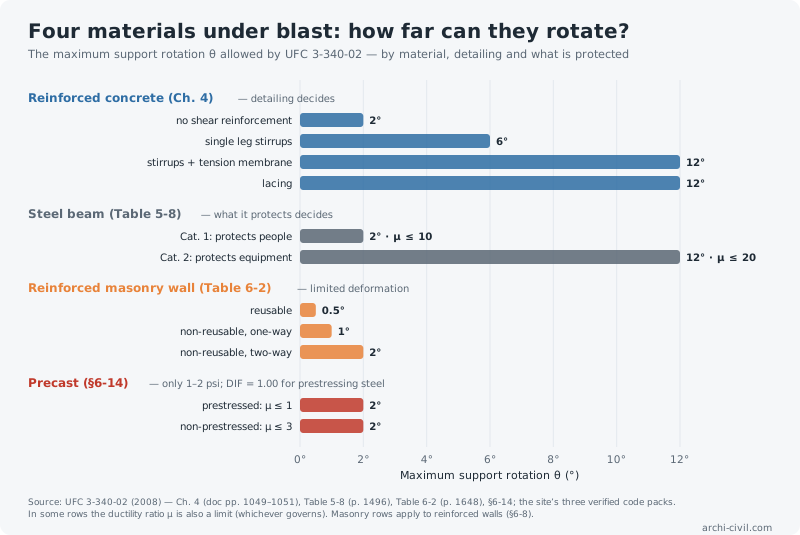
In reinforced concrete detailing sets the rotation, in steel what is protected does; masonry and precast elements cannot go beyond 2°. UFC 3-340-02 Chapter 6: masonry wall limits, the μ ≤ 1 rule for prestressed members, rebound, and connection rules that teach the same lesson as earthquakes.
1. Four materials, four answers
In the protective structures series we asked the same question for two materials: how far can a member rotate under blast? In reinforced concrete detailing answers it (PRT-04); in steel, what the member protects (PRT-07). Chapter 6 of UFC 3-340-02 asks it for two more materials: masonry and precast concrete. This time the answer is short: not much.
2. Reinforced masonry walls
Masonry walls protect well against fire, noise and flying debris and can be economical for low blast pressures. But UFC states their limits plainly: limited capacity for large deformations, reduced rebound capacity due to tensile cracking in the primary phase, and limits on the amount and type of reinforcement (§6-7). The recommended maximum support rotations for reinforced masonry walls (Table 6-2, §6-8):
- Reusable wall: 0.5° one-way and two-way.
- Non-reusable wall: 1.0° one-way, 2.0° two-way.
The dynamic increase factors for concrete masonry are 1.19 in flexure, 1.00 in shear, 1.12 in compression; for reinforcement 1.17 in flexure. Non-reinforced masonry walls are treated in a separate section (§6-9).
3. Precast concrete elements
UFC lists the advantages of precast construction (speed, protection against fragments, economy), but also states its main limitation plainly: precast members are economical only at low pressure levels of about 1–2 psi; at higher pressures cast-in-place concrete or steel is required (§6-10). The recommended deformation limits (§6-14):
- Prestressed flexural members: θ ≤ 2° or μ ≤ 1 — the member must remain essentially elastic.
- Non-prestressed flexural members: θ ≤ 2° or μ ≤ 3.
- Compression members: μ ≤ 1.3.
One detail of the dynamic increase factors stands out: concrete in compression 1.19, ordinary reinforcement 1.17, welded wire fabric 1.10; but 1.00 for prestressing steel. A prestressing strand gains no strength from fast loading.
4. Rebound: the hidden weakness of prestressed members
After the blast, the member vibrates and bends the other way. In a prestressed member, the side that was the compression zone during loading is put into tension in rebound; if there is no reinforcement there to carry tension, the member can fail in this phase. UFC therefore requires non-prestressed reinforcement to be added there, and the rebound resistance to be no less than one-half of the blast resistance (§6-15.2).
5. Connections: the same lesson in earthquakes and blasts
In BA-02 we saw that in a precast building the weakest link is the connection. UFC’s rules for blast repeat this lesson from another direction (§6-16):
- Blast loads are preferably transferred through simple beam action; with large rotations, moment-resisting connections would be very heavy and expensive.
- No dynamic increase factor is used for the capacity of a connector.
- To account for its brittleness, the connection capacity should be at least 10% greater than the reaction of the connected member.
- Failure should be governed by tension or bending of the steel, not by pull-out of the concrete.
The seismic code and the blast manual say the same thing: the connection must not break before the members.
6. Rules
- Choose the material for the threat. Masonry and precast members are for low pressures.
- Keep the prestressed member elastic. μ ≤ 1 is a limit, not a suggestion.
- Do not forget rebound. Put reinforcement in the compression zone too.
- Make the connection stronger than the member. At least 10%, with ductile failure in the steel.
References
- U.S. DoD (2008). UFC 3-340-02: Structures to Resist the Effects of Accidental Explosions — Chapter 6: §6-7, §6-8 and Table 6-2 (doc p. 1648), §6-9, §6-10, §6-12 (precast DIF), §6-14, §6-15.2, §6-16; Chapter 4 and Table 5-8 (comparison).
- archi-civil.com data/code-packs/US/ufc-3-340-02-ch6.json (string-compared with the official text) — tests/v617-prt08.test.js.
The numbers in this article were produced by the site's engines; code values are given with their clause numbers.