
Home / Articles / Protective Structures PRT-06
Standoff Distance: The Cheapest Protection Against Blast
Doubling the distance cuts blast pressure more than three-fold. UFC 4-010-01 turns this into tables by wall type and level of protection. What do the tables say, how reliable are they, and where do they contradict themselves?
1. Why is distance the cheapest protection?
Blast pressure falls with distance not linearly but much faster. The governing quantity is the scaled distance: Z = R / W1/3. According to the site’s blast engine, the free-field incident pressure of a 250 kg TNT-equivalent explosion is 72.7 kPa at 20 m, 19.4 kPa at 40 m and 7.4 kPa at 80 m: doubling the distance cuts the pressure 3.75-fold in the first step. Strengthening a wall is expensive; moving a barrier back a few metres often is not.
2. The UFC 4-010-01 approach
The U.S. Department of Defense minimum antiterrorism standards define two distances for inhabited buildings: a minimum standoff that must always be provided, and a conventional construction standoff beyond which the building need not be specially designed for blast. The tables in Appendix C (C-1…C-4) give this second distance for four levels of protection (very low, low, medium, high), nine conventional wall types and six charge weights.
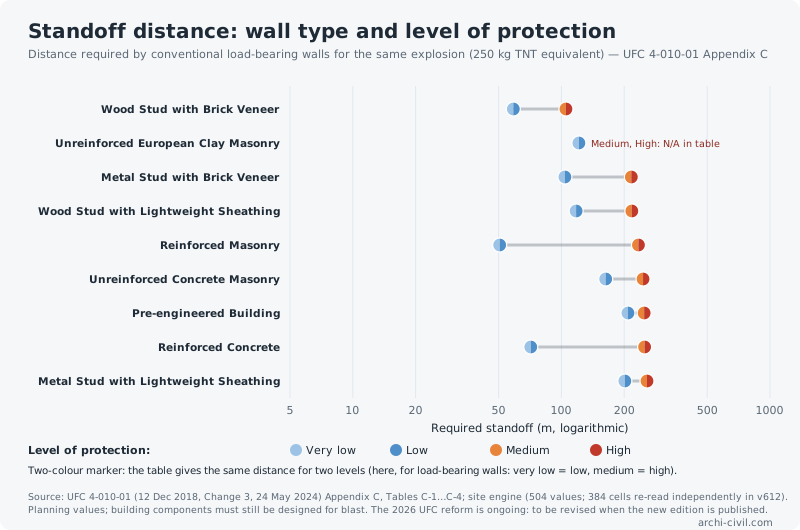
3. What does the figure say?
- Wall type changes the distance up to four-fold. At the low level, reinforced masonry needs 51 m, a pre-engineered building 209 m.
- The level of protection enlarges the distance, sometimes greatly: for reinforced masonry, going from low to medium raises it from 51 m to 234 m.
- 251 m for reinforced concrete? Yes, at the medium level. This does not mean concrete is weak: the tables describe conventional construction not designed for blast. Per the source’s own note these are planning values; if the distance cannot be provided, building components must be designed for blast (see PRT-04).
- A pattern: for 250 kg the tables give the same distance for very low and low, and for medium and high, in every load-bearing wall; non-load-bearing walls show no such equality. The figure marks this with two-colour markers.
4. How reliable are the tables?
The site’s engine parses the 504 values of Appendix C programmatically from the PDF text layer and checks every foot value against the printed metre value. For this article four rows of each of the four tables (384 cells) were re-read independently from the same document: all agree. The engine’s parsing had already exposed two inconsistencies in the source:
- In four roof cells the ft and m values disagree; in two, the metre value equals the window row directly below (most likely a copying error). The tool uses the larger value.
- At 4,400 and 19,800 lb, for three wall types a higher level of protection gives a smaller distance. This is physically impossible (a wall meeting a stricter criterion also meets a looser one). The tool shows the UFC value and recommends the monotone envelope.
Some cells are N/A in the tables (for example medium and high for unreinforced European clay masonry at 250 kg). The source does not explain this entry in the table notes, so it is not interpreted here.
5. Rules
- Distance first, concrete second. Distance is the most effective and often the cheapest variable in blast design.
- The table is a decision tool, not a design. If the required distance cannot be provided, components are designed for blast.
- Choose the wall type early. For the same level of protection the required distance varies several-fold with wall type.
- Take the safe side against the source’s inconsistencies. The monotone envelope and the larger value.
References
- U.S. DoD. UFC 4-010-01 DoD Minimum Antiterrorism Standards for Buildings, 12 December 2018, Change 3 (24 May 2024) — Appendix C, Tables C-1…C-4 (pp. 75–78), note 7.
- USACE. ECB 2026-13, Reformed Unified Facilities Criteria (UFC) and Modernized WBDG, 18 June 2026.
- Kinney, G. F.; Graham, K. J. (1985). Explosive Shocks in Air, 2nd ed.. Springer (site blast engine).
- archi-civil.com engine/ufc-4-010-01-standoff.js (504 values, v520) and independent re-reading (384 cells): tests/v612-prt06.test.js.
The numbers in this article were produced by the site's engines; code values are given with their clause numbers.