
Home / Articles / Protective Structures PRT-07
Steel Under Blast: Rate Gain, Strain Hardening and Whom You Protect
Steel grows stronger when loaded fast, but strong steel grows less. UFC 3-340-02 Chapter 5’s dynamic design stress, the six-fold difference between protecting people and equipment, and a point where the source contradicts its own rule.
1. From concrete to steel
In PRT-04 we saw the two key ideas for a reinforced concrete member under blast: fast loading strengthens the material (DIF), and detailing sets the rotation capacity. Chapter 5 of UFC 3-340-02 asks the same questions for steel; the answers differ, and at one point the source contradicts its own rule.
2. Dynamic design stress: two factors
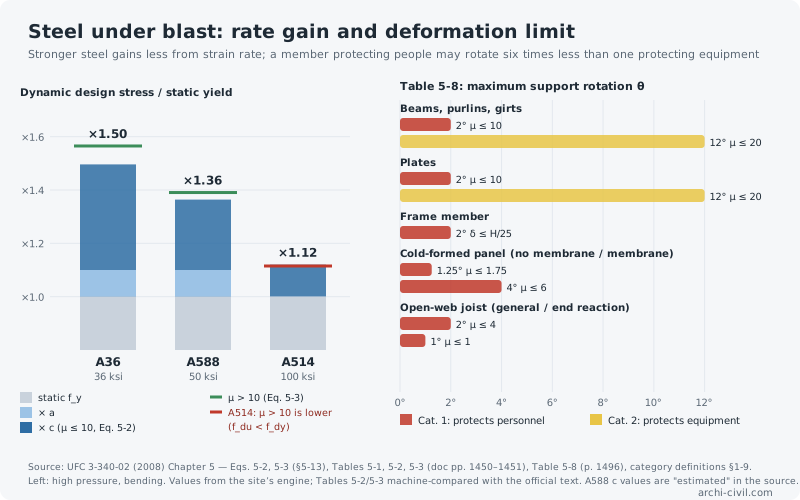
The blast design stress of a steel member comes from two factors (Eq. 5-2): fds = fdy = c · a · fy. a reflects how much the actual yield strength exceeds the specified minimum on average: 1.1 for steels with a specified minimum yield of 50 ksi or less, 1.0 otherwise. c is the dynamic increase factor, which depends on strain rate (Table 5-2):
| Steel | Bending, low pressure | Bending, high pressure | Axial, low | Axial, high | Ultimate (Table 5-3) |
|---|---|---|---|---|---|
| A36 | 1.29 | 1.36 | 1.19 | 1.24 | 1.10 |
| A588* | 1.19 | 1.24 | 1.12 | 1.15 | 1.05 |
| A514 | 1.09 | 1.12 | 1.05 | 1.07 | 1.00 |
(*"Estimated" in the source.) The table’s message is plain: the stronger the steel, the less it gains from strain rate. In bending at high pressure the design stress of A36 rises to 1.50 times its static yield, that of A514 only to 1.12 times.
3. Using strain hardening — and a contradiction
Where large deformations can be tolerated (ductility ratio μ > 10), UFC recommends using the strain-hardening region (Eq. 5-3): fds = fdy + (fdu − fdy)/4, with fdu = cu · fu and no factor a. For A36 and A588 this raises the stress (×1.57 and ×1.39).
For A514 the opposite happens. For 100 ksi A514, fdy = 1.0 · 1.12 · 100 = 112 ksi, but fdu = 1.00 · 110 = 110 ksi: the dynamic yield stress exceeds the dynamic ultimate stress, and the "use strain hardening" equation lowers the design stress (111.5 ksi). The source does not address this; the site’s engine issues a note in this case.
4. The deformation limit: whom are you protecting?
Table 5-8 ties the maximum support rotation and ductility ratio of steel members to the protection category (whichever governs). Category 1 protects personnel; Category 2 protects equipment, supplies and stored explosives (§1-9). For a beam the difference is striking: protecting people, θ ≤ 2°, μ ≤ 10; protecting only equipment, θ ≤ 12°, μ ≤ 20. Frames are also limited to a storey drift of H/25; cold-formed panels without tension-membrane action are limited to just 1.25°.
The comparison with concrete is instructive: in reinforced concrete, detailing sets the rotation capacity (2°, 6°, 12°); in steel, the material being ductile, the limit is set by what the member protects.
5. Two defects in the source itself
- Typesetting of Table 5-1: the fu column is printed empty and both values appear in the fy column (e.g. "36 58" for A36). Which is which is clear from the column order.
- A514 and Eq. 5-3: the contradiction described above.
6. Rules
- High-strength steel gains less under blast. Do not rely on dynamic increase for steels such as A514.
- Factor a applies to yield only. Not to ultimate strength.
- Decide the category first. The limit for a member protecting people is six times smaller than for one protecting equipment.
- Test the equations. A formula combined with table values can give unexpected results; A514 is an example.
References
- U.S. DoD (2008). UFC 3-340-02: Structures to Resist the Effects of Accidental Explosions — Chapter 5: §5-13.2–5-13.3 (Eqs. 5-2, 5-3; doc p. 1447), Table 5-1 (p. 1450), Tables 5-2 and 5-3 (p. 1451), Table 5-8 (p. 1496); §1-9 protection categories.
- archi-civil.com data/code-packs/US/ufc-3-340-02-ch5.json (Tables 5-2/5-3 machine-compared; 5-1 and 5-8 checked against page renderings) and engine/ufc-steel-blast.js — tests/ufc-steel-blast.test.js.
The numbers in this article were produced by the site's engines; code values are given with their clause numbers.