
Home / Articles / Shelters SIG-02
Explosion in the Ground: How Much Shock Reaches a Buried Shelter?
Being underground protects from air pressure, but the explosion’s energy passes into the soil. UFC 3-340-02’s ground-shock relations, the site’s engine tested against the source’s own worked example, two typesetting errors in the procedure, and surface versus buried bursts.
1. Underground protects, but how?
Putting a shelter underground largely protects it from air pressure and fragments. But part of the explosion’s energy passes into the ground and travels as a wave: ground shock. For a buried structure, the main load is this motion of the soil. The site had two engines for it but no article explaining them: one computes the shock from a surface burst, the other from a charge detonating in the ground.
2. Surface burst: shock arriving by two routes
UFC 3-340-02 describes the ground shock from a surface burst with two components. In air-blast-induced shock, the pressure wave striking the ground pushes the soil down; the vertical velocity is the peak pressure divided by the soil’s acoustic impedance (density × seismic velocity) (Eq. 2-74). In direct-induced shock, energy passes from the burst point directly into the ground; test-based relations give the vertical velocity as 150·ZG−1.5 in/s (Eq. 2-85). The source’s procedure adds horizontal components and arrival time.
3. The site’s engine against the source’s own example
Right after the procedure, UFC gives a worked example (Example 2A-18: a 5,000 lb surface burst at 155 ft). The site’s engine reproduces all of its results: air-induced vertical velocity 1.125 in/s, displacement 0.0142 in, acceleration 3.44 g; direct-induced vertical displacement 0.1198 in, velocity 6.02 in/s, vertical and horizontal acceleration 7.56 and 3.78 g.
The example also exposes two typesetting errors in the source’s own procedure:
- Eq. 2-76 (vertical acceleration) is printed in the procedure as “1000·Pso/(ρ·Cp·g), g = 32.2 ft/s²”; the example solves it with “100” and finds 3.44 g. As printed, the result would be ten times larger (34.4 g). Physics shows which is right: with a 1 ms rise time and a 20% allowance the acceleration is 1200·Pso/(ρ·Cp)/386.1 in/s², which is the same number as 100/32.2.
- Eq. 2-83 (vertical displacement in soil) has a coefficient of 0.017 in the procedure and 0.17 in the example; the example’s result and the original source (Odello, 1976) confirm 0.17.
In the example the peak pressure is also read as 13 psi and then used as 12.8 psi, and the procedure gives two different equations the same number (2-74). The site’s engine uses the correct value in both errors.
4. Explosion in the ground
For a buried shelter the main threat is a weapon that penetrates the soil and detonates in it. The site’s second engine computes this case with the relations of the work underlying TM 5-855-1 (Drake and Little, 1983): peak particle velocity f·160·Z−n ft/s. Here n is an attenuation exponent depending on the soil and f the coupling factor: 1 for a fully buried burst, much smaller for shallow partial burial (e.g. 0.14). That source is not at hand, so we could not audit the engine line by line; the engine checks internally that its acceleration relation follows from its velocity relation by dimensional analysis.
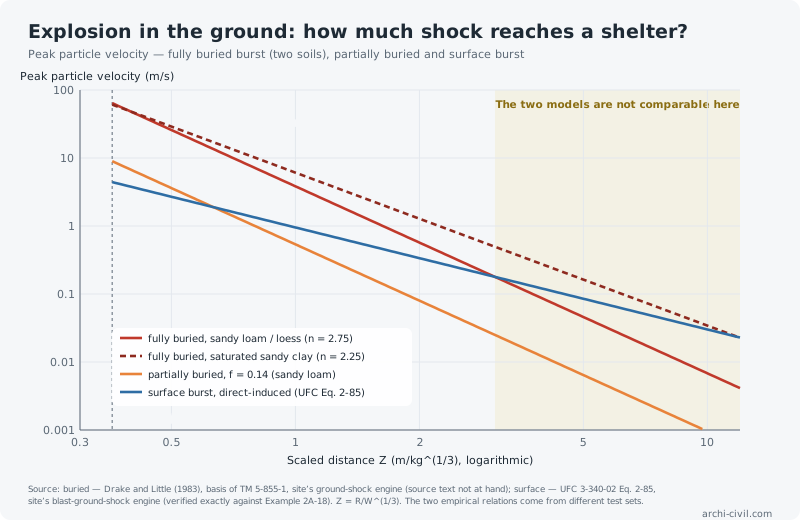
The figure teaches three lessons:
- Coupling is everything. In the near field a fully buried burst produces about 10 times the particle velocity of a surface burst at the same scaled distance.
- Soil sets the reach. Saturated sandy clay carries the shock much farther than loose soil (about 3.5 times at scaled distance 5).
- Models hold within their data ranges. Beyond a scaled distance of about 3, the surface relation starts to give higher velocities than the buried burst. Physically this is not expected; the two empirical relations come from different test sets and are not comparable there.
5. For shelter design
- Define the threat correctly. A surface burst and a penetrating weapon are very different loads for a buried structure.
- Know the soil. Seismic velocity, density and the attenuation exponent set the size and reach of the shock.
- Know a relation’s source and range. An empirical formula can mislead outside the test range it came from.
- Test the source with its worked example. As here, an example can expose errors in the procedure.
References
- U.S. DoD (2008). UFC 3-340-02 — ground-shock procedure (Eqs. 2-74–2-92) and Example 2A-18 (doc pp. 462–467).
- Odello, R. J. (1976). Ground Shock Effects from Accidental Explosions, Picatinny Arsenal TR 4995 (primary source of the site’s surface engine).
- Drake, J. L. and Little, C. D. (1983). Ground Shock from Penetrating Conventional Weapons, U.S. Army WES; basis of the ground-shock chapter of TM 5-855-1 (1986) (source of the site’s buried engine; text not at hand).
- archi-civil.com engine/blast-ground-shock.js and engine/ground-shock.js — tests/v626-sig02.test.js.
The numbers in this article were produced by the site's engines; code values are given with their clause numbers.