Home / Simulations / Base Isolation Explorer
🏢 Base Isolation Explorer
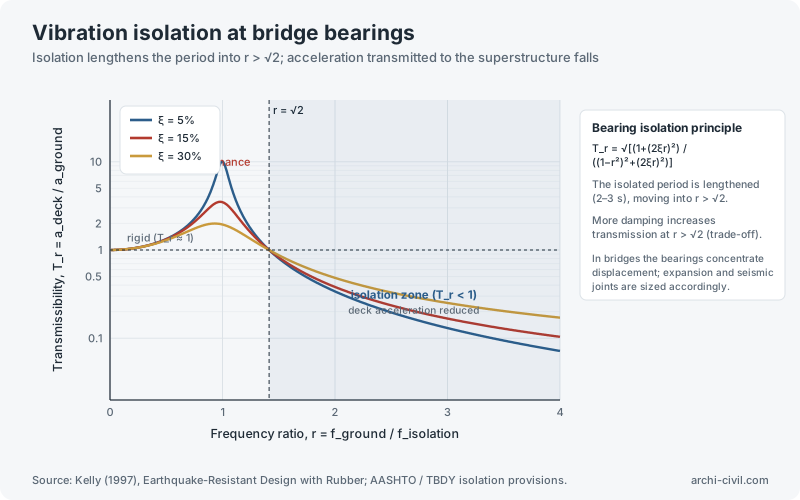
Instead of making a building strong enough to survive the shaking, disconnect it from the ground. Lead-rubber bearings lengthen the period far past the spectrum's dangerous plateau and dissipate energy in a fat hysteresis loop. The catch: the building now moves nearly a metre, and something has to accommodate that gap.
Isolation System
Building & Site
Live Result
—
Design displacement D—
Effective isolated period Teff—
Equivalent damping βeq—
Damping reduction η—
Base shear (isolated)—
Base shear if fixed-base at plateau—
Powered by bilinear isolator theory with the
equivalent-linear (secant stiffness + equivalent viscous damping) method
(
engine/base-isolation.js). Verified before publishing: the
equivalent damping computed from the hysteresis loop area matches the
independently-stated closed form β = 2Qd(D−Dy)/(πKeffD²)
to machine precision, η returns exactly 1.000 at the 5% reference damping, and
the design displacement is solved by iteration then verified to satisfy its
own defining equation — a genuine fixed point, not merely the last
iterate. Keff is confirmed to always lie strictly between the
post-yield and initial stiffness.Method
Naeim & KellyBilinear lead-rubber bearing model; Keff = Kd + Qd/D, Wd = 4Qd(D−Dy).
EN 1998-1 §10Damping reduction η = √(0.10/(0.05+ξ)) ≥ 0.55.
Scope: equivalent-linear analysis of the isolation system only. Does NOT model superstructure flexibility, bidirectional interaction, velocity dependence, lead-core heating, bearing stability/buckling, or uplift — all of which matter in real isolation design. A teaching tool, not a bearing specification.
Visual explanation