Home / Tools / Blast Leakage into a Room Protective · Blast

Blast Pressure Leakage Through an Opening

Average interior pressure-time history of a room or shelter filled through a small opening by an external triangular blast load — analytic orifice-fill model, compared with the step method of the Handbook for Blast-Resistant Design of Buildings (§13.4.1).

Room and opening

External load (triangular)

Analytic model: isentropic fill of the room through an orifice (flow proportional to the square root of the pressure difference). Cd ≈ 0.6 for a sharp-edged opening. Valid for external pressures up to 5 psi (about 34 kPa); higher pressures need compressible-flow treatment (UFC 3-340-02 §2-14).

Results

Peak average interior pressure—
Time of peak · interior/exterior ratio—
Handbook step method (comparison only)—
t (ms)P (psi)Pi analytic (psi)Pi handbook (psi)
ModelIsentropic fill through an orifice: dPi/dt = γ·(Pa + Pi)·Cd·A·√(2ΔP/ρ)/V, integrated with fourth-order Runge–Kutta. Verified against closed-form solutions (constant external pressure: the result lies between the two exact bounds; initial slope within 2 %).
Handbook comparisonDusenberry, D. O. (ed.), Handbook for Blast-Resistant Design of Buildings, Wiley, 2010, §13.4.1 (after TM 5-1300). Its worked table uses a leakage coefficient proportional to the pressure difference; orifice flow is proportional to its square root, so the handbook method under-predicts the interior pressure at small pressure differences — on its own example the analytic peak is 0.74–0.83 psi (Cd 0.6–0.7) against 0.69 psi, and at 0.5 psi external pressure the handbook value is about half. The handbook column is shown for comparison only.

Visual explanation

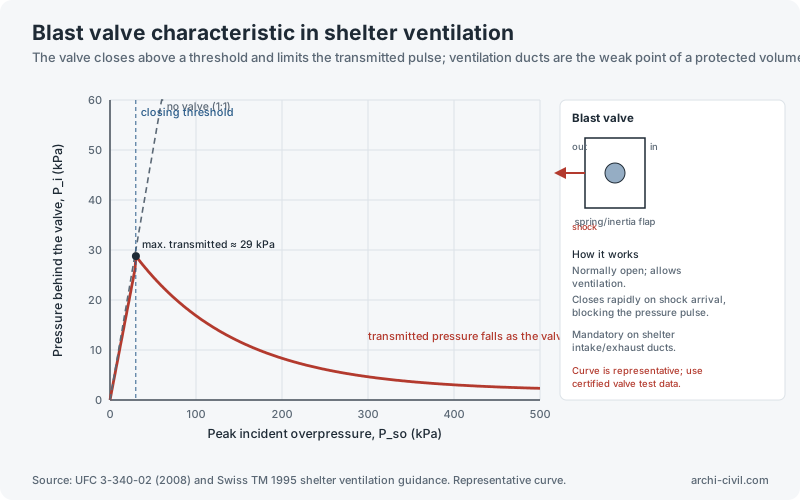
Blast valve characteristic in shelter ventilation. The valve closes above a threshold and limits the transmitted pulse; ventilation ducts are the weak point of a protected volume
Figure 47. Blast valve characteristic in shelter ventilationSource: UFC 3-340-02 (2008) and Swiss TM 1995 shelter ventilation guidance. Representative curve.

Preliminary calculation tool. Final design requires the full text of ACI 318 and review by a licensed PE. This tool follows ACI 318-19, the edition referenced by the 2021 and 2024 IBC; ACI CODE-318-25 was published in January 2025 and is expected in the 2027 IBC (changes include development length equations and seismic provisions).