
Home / Tools / Missile Barrier N · Protective
Concrete Barrier Against Hard-Missile Impact — Penetration, Scabbing, Perforation
Required reinforced-concrete barrier thickness against a non-deforming missile, by the nuclear-safety design methods: modified NDRC penetration (Kennedy 1976), Chang scabbing and Degen perforation (the NEI 07-13 / DOE-STD-3014 set), with NDRC/ACE and CEA-EDF for comparison and a code-dependent design factor. For protective design of shelters, barriers and nuclear-plant structures.
Missile
Barrier
Results
NDRC G · branch · N—
Penetration depth x (x/d)—
Required thickness (with design factor)—
Parça çapraz kontrolü (v526)Bu aracın Kennedy-NDRC uygulaması, UFC 3-340-02'nin standart birincil parça denklemleriyle (Dusenberry (ed.) 2010, Denk. 8.28–8.29; 4 000 psi) karşılaştırıldı: UFC denklemleri %7–12 daha derin penetrasyon verir (daha muhafazakâr; NDRC saçılımı ±%25 içinde). Kitabın ağırlık biçimli denklemleri parça ağırlığını ONS cinsinden ister. Kitabın √(4 000/f′c) dayanım düzeltmesi derin penetrasyonda NDRC ile tutarlı, sığ penetrasyonda fazla güçlüdür (yüksek dayanımlı betonda sığ penetrasyonu küçük gösterir).
NDRCG = 3.8×10⁻⁵·N·M/(d·√f′c)·(V₀/d)1.8 with f′c in Pa; x/d = 2√G for G ≤ 1, G + 1 for G > 1 (one review prints this inequality inverted).
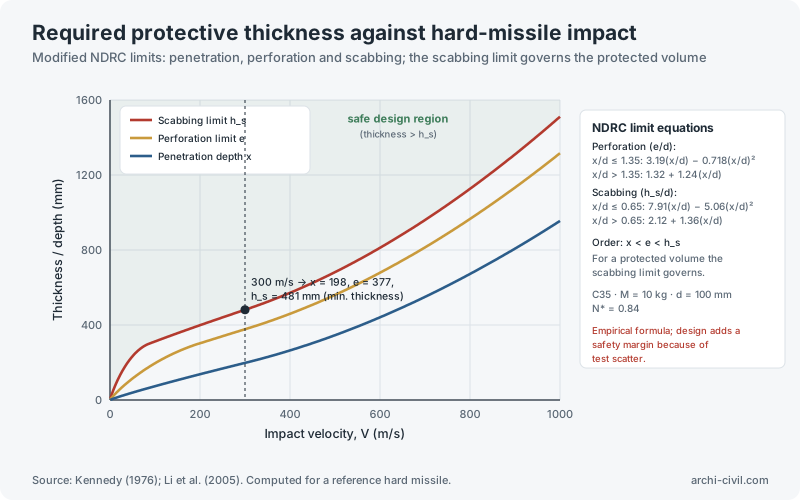
Scabbing / perforationNDRC/ACE: hs/d = 7.91x/d − 5.06(x/d)² (x/d ≤ 0.65), 2.12 + 1.36x/d; e/d = 3.19x/d − 0.718(x/d)² (x/d ≤ 1.35), 1.32 + 1.24x/d. Degen: e/d = 2.2x/d − 0.3(x/d)² (x/d < 1.52), 0.69 + 1.29x/d. Chang: e/d = (61/V₀)0.25(MV₀²/(d³f′c))0.5, hs/d = 1.84(61/V₀)0.13(MV₀²/(d³f′c))0.4. CEA-EDF: e/d = 0.82M0.5V₀0.75/(ρc0.125f′c0.375d1.5).
VerifyNuScale turbine-missile barrier (NRC submittal): ts 26.1 → 31.3 in, tp 22.9 → 27.5 in — reproduced. EPRI/Calspan pipe tests (MCEER-17-0004): NDRC predicted/measured ratios reproduced with flat nose N = 0.72. IRIS P1 (0.25 m slab, 136 m/s): every formula predicts perforation, as observed. Main source: Li, Reid, Wen & Telford (2005), Int. J. Impact Eng. 32:224–284.
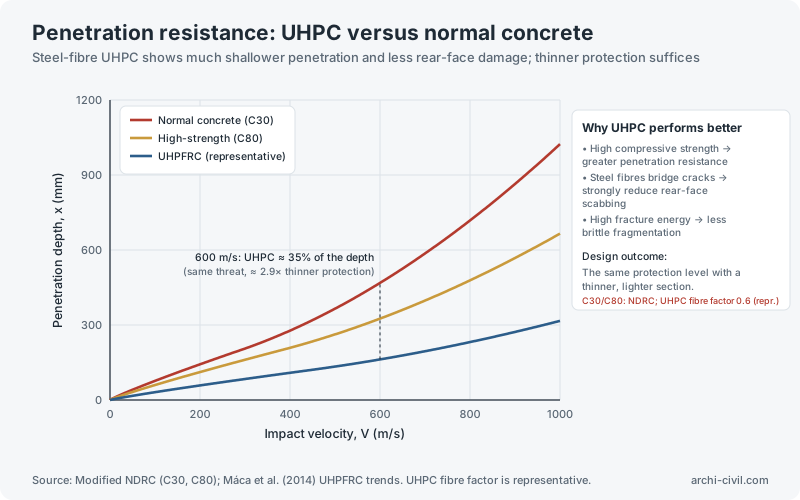
UHPCThe formulas are calibrated for normal-strength concrete. Above the limit the calculation uses the limit strength by default (no credit for high-strength or UHPC). Evidence is regime-dependent: shallow-impact tests (same projectile, 41–162 MPa) show penetration falling as f′c−0.43, faster than the f′c−0.25 of NDRC, so NDRC is conservative there; one deep-penetration UHPC data set (160 MPa) shows the opposite and remains unresolved.
AccuracyNo empirical formula is better than about ±20–40% (Sliter 1980: NDRC ±25% for x/d > 0.6) — hence the design factor and the envelope option.
Visual explanation
Preliminary calculation tool. Final design requires the full text of the referenced standard (see the sources on this page) and review by a licensed PE.