
Home / Articles / Shelters SIG-06
The Last Two Gaps: Shelter Walls in Fire and Contact Explosions
A new fire engine based on TS EN 1992-1-2 as in force in Türkiye (the 2023 edition as a transition mode), and a conservative contact-explosion damage classification tested against experiments.
1. The last two gaps
SIG-05 ended with two gaps: fire resistance of an RC shelter wall, and spall and breach under a contact explosion. A second source research effort closed both; this article explains what was implemented, which decisions were taken, and what was deliberately left out.
2. Fire: which edition?
TS EN 1992-1-2, in force in Türkiye, was adopted by the TSE Technical Board on 30 November 2006 on the basis of EN 1992-1-2:2004; a corrigendum and amendment were added later. The second-generation edition (EN 1992-1-2:2023) has been published by CEN, but no record of its adoption by TSE was found. Under CEN’s timetable, first-generation editions are to be withdrawn by 30 March 2028 at the latest.
The site’s new fire engine therefore uses the 2004 edition by default (Table 5.3 for non-load-bearing, Table 5.4 for load-bearing walls); the 2023 tables are added as a separate transition mode. Because the 2023 values rest on a single peer-reviewed paper (Carrascón et al., 2023), the engine says so in every result. The standard’s tables are copyrighted, so the site does not reproduce them; the engine uses the values in its calculation and shows the result with a citation.
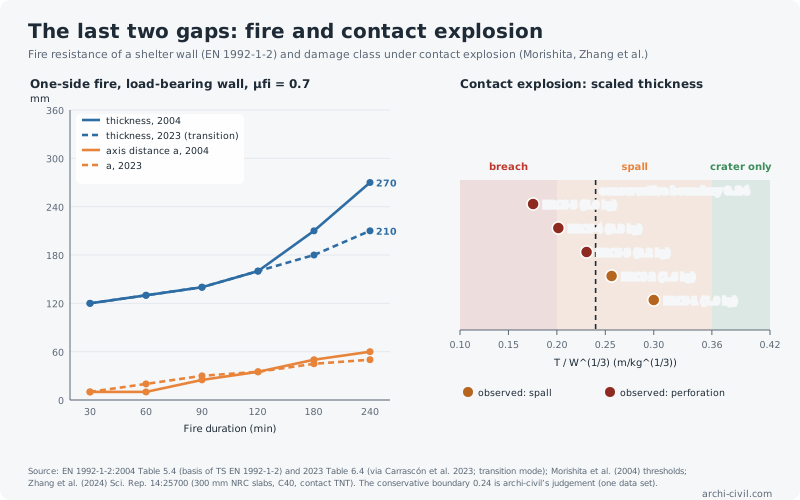
For a shelter wall the result is instructive: a 300 mm load-bearing wall exposed on one side at load level μfi = 0.7 achieves REI 240 with a 60 mm axis distance, but only REI 120 with 40 mm. The governing quantity is often not the thickness but the axis distance. Up to 120 minutes the two editions agree; for longer durations the 2023 edition requires less thickness for short walls (210 instead of 270 mm for REI 240). The concrete cover rules of the Turkish Fire Protection Regulation must be satisfied separately.
3. Contact explosion: which model?
The spall and breach clause of UFC 3-340-02 (§4-55) has a curious history: Change 1 in 2014 added new thresholds, and Change 2 rescinded them because “the equations were mistakenly based on SI units”. Correction (v634): this sentence previously said “the current equations could not be verified”; that was wrong. Change 2 restored the clause to the 5 December 2008 text, which we have; the site’s UFC engine implements the equations exactly (verified by independent recalculation). UFC’s contact mode gets 4 of 5 Zhang tests right. Contact charges are therefore now assessed jointly: UFC §4-55 and Morishita (including the conservative mode) are both computed and the least favourable class governs (5/5).
Instead, the contact-explosion thresholds of Morishita et al. (2004), used repeatedly in the open literature, were implemented. For scaled thickness T/W1/3 (m/kg1/3) above 0.36 only a crater is expected, between 0.20 and 0.36 spall, below 0.20 breach. These thresholds were tested against five experiments in the open-access paper of Zhang et al. (2024) (300 mm C40 slabs, 1–5 kg TNT): Morishita classifies three of five correctly; for the 2.2 and 3.3 kg tests it predicts “spall” where perforation was observed, i.e. on the unsafe side. The engine therefore offers a second conservative mode: with the breach boundary moved to 0.24, all five tests agree. This boundary is our judgement and rests on a single data set; the engine states this.
Example: for a 10 kg contact charge, preventing breach requires at least 0.43 m by Morishita, 0.52 m in conservative mode; preventing spall requires 0.78 m.
4. Connected to the chain (v633)
Both engines were added to the shelter wall design chain as optional steps. A contact charge is entered as a separate threat and must not breach the wall; for fire the required duration is chosen and the wall is checked by thickness and axis distance. If the axis distance is not given, the cover is used conservatively. Example: a 400 mm wall is breached by a 10 kg contact charge; with this threat added, sizing proposes 550 mm (v634 joint assessment). The chain’s spall step for stand-off explosions implements UFC §4-55 exactly; UFC has no worked example for this case.
5. Limits
- The fire tables apply only to braced structures with h/t ≤ 40; the engine checks this. The 2023 non-load-bearing wall table was not found in the sources, so only 2004 can be used for such walls.
- The contact-explosion thresholds apply to normal-strength concrete (about 17–48 MPa) and charges placed on the surface; soil-covered (buried) walls, fibre-reinforced and ultra-high-performance concrete are out of scope.
- Close-in (non-contact) explosions are computed with UFC §4-55 within Ψ = 0.5–14; outside that range the engine reports “undetermined”. Independent test-data validation for this case has not yet been done.
References
- TS EN 1992-1-2 (2006; based on EN 1992-1-2:2004, +AC, +A1) — Tables 5.3, 5.4; §5.4.1–5.4.3.
- Carrascón, S., Robert, F. and Villagrá, C. (2023). Some Highlights on the New Version of EN 1992-1-2. Hormigón y Acero 74(299–300):223–234, doi:10.33586/hya.2023.3096.
- CEN/TC 250 N 3659 (2023). Timeline for the second-generation Eurocodes.
- Morishita, M., Tanaka, H., Ando, T. and Hagiya, H. (2004). Concrete Research and Technology 15(2):89–98.
- Zhang, W., Mao, J., Zhou, B. et al. (2024). The impacts of contact explosions on ultra-high performance reinforced concrete slabs. Sci. Rep. 14:25700, doi:10.1038/s41598-024-74774-x.
- archi-civil.com engine/ec2-fire-walls.js, engine/contact-spall.js (v632) — tests/ec2-fire-walls.test.js, tests/contact-spall.test.js.
The numbers in this article were produced by the site's engines; code values are given with their clause numbers.