
Home / Articles / Shelters SIG-04
One Shelter, Several Hazards: Earthquake, Blast, Fallout and Fire
A shelter wall in the lowest basement is also a basement wall. TBDY’s seismic earth pressure is of the same order as UFC blast pressure; the Regulation’s fallout options correspond to the same mass; fire remains an open gap.
1. One shelter, several hazards
A shelter is not designed for a single hazard. Turkey’s Shelter Regulation wants it preferably in the lowest basement; so the shelter wall is also a basement wall against soil, and takes dynamic earth pressure in an earthquake. The same wall must also protect against blast, radioactive fallout and fire. This article shows how these hazards can be compared on the same wall, and what the site has and does not have for that comparison.
2. Earthquake: earth pressure on a basement wall
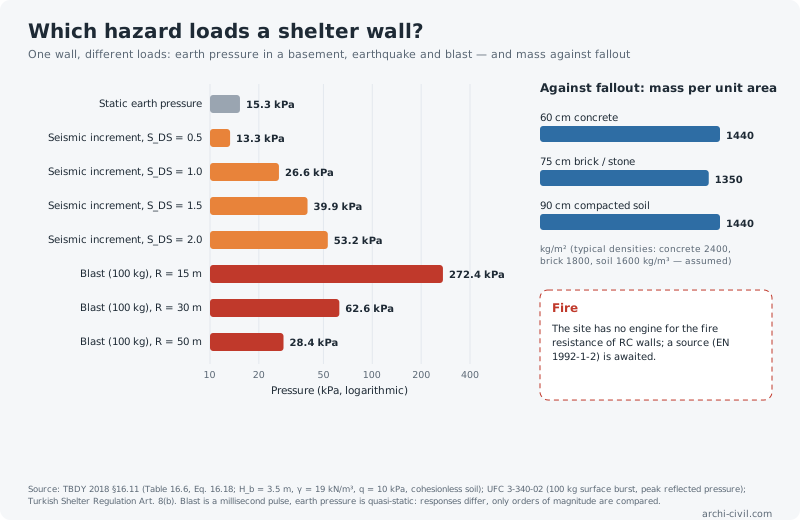
TBDY 2018 §16.11 gives the soil pressures on rigid perimeter basement walls. The static pressure is uniform along the wall: 0.2·(γ·Hb + q) in cohesionless soil (Table 16.6). In an earthquake a uniform increment is added: Δp = 0.4·SDS·γ·Hb (Eq. 16.18). For a 3.5 m basement shelter and SDS = 1.0, the static pressure is 15.3 kPa and the seismic increment 26.6 kPa: the seismic increment exceeds the static pressure. The site had no engine for this; a new engine was written and verified by hand.
For walls below the water table TBDY also gives a dynamic water pressure (Eqs. 16.19–16.20). In the text layer the square root of Eq. 16.19 is lost; but the 7/12 coefficient and the 0.6·dsu depth of the resultant are consistent only with a √(z·dsu) distribution. The engine applies that distribution, and its test confirms that the numerical integral of the distribution equals the resultant.
3. Blast and earthquake: the same order of magnitude
The peak reflected pressure of a 100 kg surface burst is 272 kPa at 15 m, 63 kPa at 30 m and 28 kPa at 50 m. The seismic increment is 13–53 kPa for SDS = 0.5–2.0. At close range blast dominates; at medium and large distances the two loads are of the same order of magnitude. The two numbers are not of the same kind: blast is a pulse lasting milliseconds and the wall’s response depends on its duration (SIG-03); earth pressure is quasi-static. The figure compares only orders of magnitude. The lesson: a shelter wall designed for blast should not be assumed to carry seismic earth pressure; check it separately.
4. Fallout: three options, one principle
The Regulation gives three options for external walls and roof: at least 60 cm of concrete, 75 cm of brick or stone, or 90 cm of compacted soil (Art. 8(b)). With typical densities (concrete 2,400, brick 1,800, soil 1,600 kg/m³; assumed), their mass per unit area is about 1,440, 1,350 and 1,440 kg/m²: almost the same. This is no coincidence; shielding against the gamma radiation of fallout depends largely on the material’s mass per unit area. The three options are three forms of the same principle. The site has no engine for radiation shielding; this section is an inference from the Regulation’s values.
5. Fire: an open gap
The fire resistance of a shelter wall depends on its concrete cover and thickness. The site’s fire engine is for unprotected steel members only (EN 1993-1-2); there is no engine for the fire resistance of a reinforced concrete wall. Rather than write it without a source, we leave it as an open gap: the source needed is EN 1992-1-2.
6. Rules
- Check each hazard separately. A wall designed for blast does not automatically resist seismic earth pressure.
- Do not underestimate the earthquake. In a basement shelter the seismic increment can exceed the static earth pressure.
- Mass matters against fallout. The Regulation’s options correspond to the same mass.
- Compare like with like. A pulse and a quasi-static load do not produce the same response.
References
- TBDY 2018 (Turkish Building Earthquake Code) — §16.11, Table 16.6, Eqs. (16.18)–(16.20).
- U.S. DoD (2008). UFC 3-340-02 — reflected blast pressure (site’s ufc-positive-phase engine, verified against Examples 2A-1/2A-10).
- Turkish Shelter Regulation, RG 25/8/1988-19910 (last amended RG 7/11/2025-33070) — Art. 8(b).
- archi-civil.com engine/tbdy-basement-pressure.js (v630) — tests/tbdy-basement-pressure.test.js.
The numbers in this article were produced by the site's engines; code values are given with their clause numbers.