
Home / Articles / Shelters SIG-09
How Reliable Is This Number? The Band Rule for Blast Loads
Three load models, two independent UFC implementations, two LS-DYNA results and published measurements: archi-civil.com’s blast-load uncertainty hub.
1. What does a single number hide?
When a blast tool says “the reflected impulse on the wall is 2496 kPa·ms”, a single empirical model stands behind that number. For the same blast another established model gives 2005 and a third 2084 kPa·ms. The difference reaches 24%, and because wall rotation grows roughly with the 1.7th power of impulse, it becomes a design difference of about 30%. A user who sees one number cannot see this uncertainty.
2. Three models and the band rule
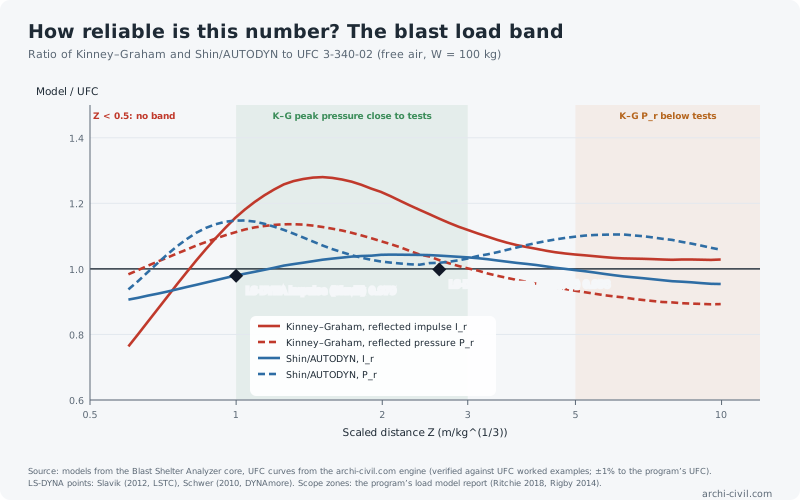
Blast Shelter Analyzer (v3.13) reports a band instead of one number: Kinney–Graham is the upper bound for reflected impulse (conservative), the UFC 3-340-02 curves are the best estimate, and Shin/AUTODYN is a third independent view. Figure 103 shows Kinney–Graham giving reflected impulse 13–28% above UFC for Z ≈ 1–3, while its peak pressure falls about 11% below UFC in the far field (Z > 5).
3. One UFC on the site
The program builds the UFC curves from polynomials; the site’s UFC engine is a digitization verified against the worked examples of UFC 3-340-02 itself. These two independent implementations give the same peak pressure and impulse within 0.71% in eight scenarios. All four pages (the program, the load model explorer, the wall response simulator, and the UFC curves and measurements page) show bit-identical numbers for the same scenario. Permanent site tests protect this agreement.
4. LS-DYNA and measurements
Two published LS-DYNA blast-load results (ConWep, *LOAD_BLAST_ENHANCED) were compared with the site’s UFC engine: the average plate impulse of 547 Pa·s for 1 kg TNT at 1 m (Slavik, 2012) gives a ratio of 0.979; the incident pressure of 0.108 MPa for 1.5 kg TNT at 3 m (Schwer, 2010) gives 0.998. Published measurements (Ritchie et al., 2018; Rigby, 2014) show Kinney–Graham peak reflected pressure close to tests for Z ≈ 1–3 and 12–18% below them for Z > 5. In the near field (Z < 0.5) the models diverge strongly and the band rule is not applied.
5. Clearing (Hudson)
On a façade of finite size, reflected pressure drops early as the wave clears around the edges. The program’s Hudson (1955) module computes this effect, but only as a sensitivity tool: it does not change the default results. The size of the effect depends on façade dimensions and charge position; using it in design needs a justification supported by measurements.
6. How does the band change design?
The band does not settle “which model is right?”; without an independently measured impulse nobody can. It gives the designer an honest choice: design with the best estimate (UFC) and check with the upper bound (Kinney–Graham). A design whose two ends stay in the same damage class is robust to load-model uncertainty. If they do not, the result is sensitive to model choice, and that must be reported.
7. Limits
- The band shows only load-model uncertainty. The wall flexure model has its own: according to the program’s report it has no experimental validation and is nearly blind to concrete strength.
- The LS-DYNA points test the load itself, not the structural response.
- Measurements cluster in certain Z ranges; between them, model accuracy has not been tested against measurements.
References
- U.S. DoD (2008). UFC 3-340-02, Figures 2-7 and 2-15.
- Kinney, G. F. and Graham, K. J. (1985). Explosive Shocks in Air. Springer.
- Shin, J., Whittaker, A. S. and Cormie, D. (2015). Incident and normally reflected overpressure and impulse for detonations of spherical high explosives in free air. J. Struct. Eng. 141(12).
- Hudson, C. C. (1955). Sound pulse approximations to blast loading. Sandia SC-3486.
- Ritchie, C. et al. (2018) and Rigby, S. E. (2014) — published measurements (the program’s load model report).
- Slavik, T. (2012). Blast Loading in LS-DYNA. LSTC; Schwer, L. E. (2010). DYNAmore Forum J-I-01.
- archi-civil.com tools/blast-shelter-analyzer.html (v3.13), engine/ufc-positive-phase.js — tests/v644-load-band.test.js, tests/v643-load-model-hub.test.js.
The numbers in this article were produced by the site's engines; code values are given with their clause numbers.