
Home / Articles / Shelters SIG-01
Shelters in Turkey: Who Must Build One, and What Must It Be Like?
Turkey’s Shelter Regulation with its 2025 amendment: thresholds, the dimensions and equipment of a fallout shelter — and a dangerous silent default we found in the site’s shelter engine.
1. Why a shelter series?
This site had two calculation tools and two games for shelters, but not a single article explaining them. This series closes that gap, and each article audits the engine of the tool it describes line by line against its source. The first article starts with the legislation: who must build a shelter in Turkey, and what must a shelter be like?
2. Two kinds of shelter
The Regulation classifies shelters in two ways (Articles 5–6). By whom they protect: private shelters for a building’s users and public shelters for collective use, coordinated by AFAD. By purpose: pressure shelters built by the state, which also protect against the immediate effects of nuclear weapons, and fallout shelters, which protect against radioactive fallout, chemical and biological agents, attenuated blast and heat, and fragments of conventional weapons. Buildings must provide fallout shelters, preferably in the lowest basement.
3. Who must build a shelter?
A fallout shelter is required in every kind of building except the listed exemptions (Article 7). After the 2025 amendment the main exemptions are: residential-only buildings with fewer than 10 units (previously “12 or fewer”); non-residential buildings under 1,500 m² of floor area and government buildings under 1,000 m²; dormitories and hotels with 50 beds or fewer, care homes and inpatient health facilities with 25 beds or fewer; manufacturing and industrial facilities under 2,000 m²; sports facilities with fewer than 5,000 spectators.
Transitional rule: for buildings whose permit application was filed before the amendment (and for “nation’s garden” projects, buildings with notarised construction contracts under Law 6306, and public works with a tender decision or date), the former Article 7 applies on request (Provisional Article 2). So the old threshold may still apply in these cases.
4. What must a shelter be like?
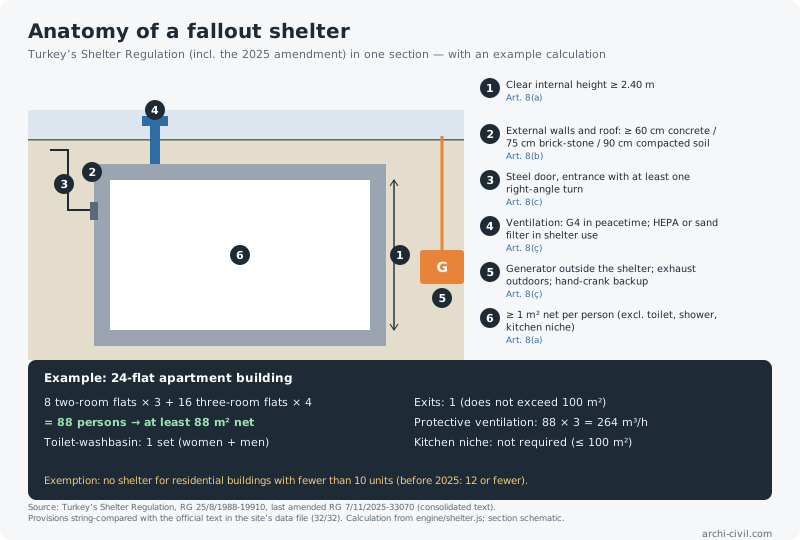
Article 8 defines size and equipment: at least 1 m² net per person (excluding toilet, shower and kitchen niche); for housing, per unit 2 persons for one-room, 3 for two-room and 4 for three or more rooms; for accommodation, the number of beds plus 20%; for other buildings, the floor area divided by 20; clear internal height at least 2.40 m; external walls and roof at least 60 cm concrete, 75 cm brick or stone, or 90 cm compacted soil; a steel door and an entrance with at least one right-angle turn, two exits for shelters over 100 m²; protective ventilation per person of 1.8 (up to 50 persons), 3 (up to 150) and 4.5 m³/h (more); a generator outside the shelter with a hand-crank backup for the fan; at least 24 hours of uninterrupted power in government, health and education buildings.
5. What we found in the site’s engine
- Correct: all exemption thresholds, occupancy rules, 1 m², 2.40 m and wall thicknesses matched the official text.
- A dangerous silent default: if the number of units was not given, the engine counted it as zero and declared the building “fewer than 10, exempt”; the tool page also turned an empty field into zero. Both are fixed: a missing decisive input now produces “a missing input is not an exemption”.
- Missing rules added: number of exits, toilet-washbasin sets, kitchen niche, ventilation rate, a roof of at least 20 cm and walls of at least 30 cm reinforced concrete for education buildings, 24-hour power. The tool now shows them.
- A rule difference: the engine applied floor area/20 to industrial facilities; for production units where the provincial board requires a shelter, the Regulation uses the largest shift and at least 20 m². This calculation was added as a separate function.
- An incomplete warning: the engine called the old “12” threshold simply “repealed”; without the transitional cases of Provisional Article 2 that was incomplete. The note is fixed.
6. An interpretation problem in the text
The toilet rule reads: one toilet and washbasin each for women and men per hundred persons; one more set if the remainder exceeds 50, none if it is less. Applied literally, a shelter for up to 50 persons needs no toilet at all, while the same article requires a flush toilet for hygiene. The site’s tool shows an interpretation note in this case and recommends at least one set in design.
7. A timetable for existing shelters
The 2025 amendment also sets deadlines for existing shelters: shelters in government buildings and in private education and health buildings providing public services are made ready immediately; shelters in other buildings are inspected by the authority within one year of entry into force (by November 2026) using the Annex 1 Shelter Inspection Form, with up to one year to remedy non-structural deficiencies (Provisional Article 4). For the existing spaces listed in Article 10 the deadline is 31/12/2028 (Provisional Article 3).
References
- Turkey’s Shelter Regulation (under Zoning Law 3194), RG 25/8/1988-19910; amendments 2/9/1999-23804, 29/9/2010-27714, 31/12/2010-27802, 7/11/2025-33070 — Articles 5–8, 10; Provisional Articles 2–4; Annex 1 Shelter Inspection Form. Official consolidated text.
- archi-civil.com engine/shelter.js (v625 audit and extension) and data/regulations/tr-siginak.json (32 provisions string-compared) — tests/v625-sig01.test.js.
The numbers in this article were produced by the site's engines; code values are given with their clause numbers.