
Home / Articles / Reinforced Concrete BA-01
Shear in TS 500: Four Measures from Diagonal Cracking to Crushing
Shear failure is brittle and gives no warning. TS 500 prevents it with four measures: diagonal cracking strength, the concrete contribution, minimum stirrups and an upper limit. With three details found while testing the site’s engine line by line against the official text.
1. Why is shear failure so feared?
A well-designed RC beam failing in flexure deflects for a long time as its reinforcement yields; it cracks and warns. In shear, the concrete can separate suddenly along a diagonal crack in the web: a brittle failure and the first failure mode to avoid in earthquake engineering. TS 500 therefore treats shear with four separate measures, each answering one failure mode.
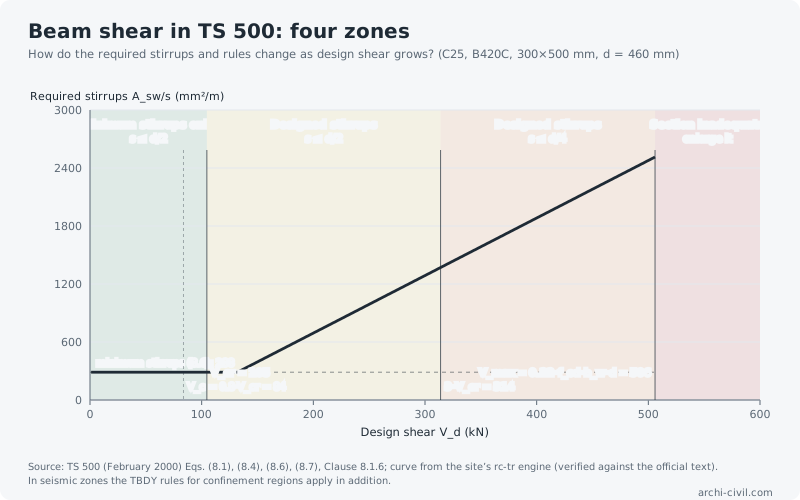
2. Four measures, four zones
- Diagonal cracking strength (Eq. 8.1): Vcr = 0.65·fctd·bw·d·(1 + γ·Nd/Ac). Axial compression delays cracking (γ = 0.07), axial tension hastens it (γ = −0.3).
- Concrete contribution (Eq. 8.4): Vc = 0.8·Vcr. Shear strength is the sum of the concrete and the stirrup contribution (Eq. 8.5).
- Minimum stirrups (Eq. 8.6): (Asw/s) ≥ 0.3·(fctd/fywd)·bw. Stirrups are mandatory along the span even when not required by calculation; once a diagonal crack forms, something must take the load.
- Upper limit (Eq. 8.7): Vd ≤ 0.22·fcd·bw·d. This limit prevents crushing of the web concrete under principal compression; no amount of stirrups can exceed it — the section must be enlarged.
Stirrup spacing also depends on the zone (Clause 8.1.6): s ≤ d/2; if design shear exceeds 3·Vcr, s ≤ d/4. At frame-beam ends, over twice the beam depth, s ≤ d/4, 8φ and 150 mm apply together.
For the example beam in the figure (C25, B420C, 300×500 mm, d = 460 mm) Vcr = 105 kN, 3·Vcr = 314 kN and the upper limit is 506 kN; minimum stirrups are 288 mm²/m.
3. What we found while testing the engine against the official text
All coefficients of the site’s TS 500 shear engine match the official text exactly. A line-by-line reading revealed three details:
- A different threshold, the same result: TS 500 says "if Vd ≤ Vcr, no shear reinforcement calculation is needed"; the engine brings in designed stirrups once Vd > Vc (= 0.8·Vcr). In the band between them the required stirrups are at most (Vcr − Vc)/(fywd·d) = 0.13·fctd·bw/fywd, below the minimum (0.3·fctd·bw/fywd). So in this band the minimum governs under both readings. A difference could arise only if the axial compressive stress exceeded about 19 MPa. This equivalence is checked point by point in the site’s tests.
- A typesetting error in the source: in the TS 500 text the clause number of the shear upper limit is printed as "8.5.1.2"; by the clause order it should be 8.1.5.2.
- A permitted relaxation not used: if the axial tensile stress is below 0.5 MPa, TS 500 allows γ = 0. The engine does not use it and stays on the safe side.
4. In seismic zones
TS 500 requires that, under earthquake action, the concrete contribution at member ends (confinement regions) be taken from the seismic code (Clause 8.1.4). The zones in this article therefore describe non-seismic design; in confinement regions the TBDY rules apply in addition.
5. Rules
- Check the upper limit first. If Vd > 0.22·fcd·bw·d, designing stirrups is pointless.
- Stirrups are always there. Minimum stirrups are mandatory even where no calculation is needed.
- Spacing matters as much as quantity. Above 3·Vcr spacing halves.
- Do not forget axial tension. In a member under tension the concrete contribution drops markedly.
References
- TSE. TS 500 Requirements for Design and Construction of Reinforced Concrete Structures (in Turkish), February 2000 — Clauses 8.1.3–8.1.6, Eqs. (8.1)–(8.7); Eq. (3.1) (fctk). Official text.
- archi-civil.com engine/rc-tr.js (beamShear) and data/code-packs/TR/ts500-rc.json — comparison with the official text and threshold equivalence: tests/v611-ba01.test.js.
The numbers in this article were produced by the site's engines; code values are given with their clause numbers.