
Home / Articles / Shelters SIG-03
The Shelter Wall Design Chain: What Tested Each Link?
Twelve engines from blast load to bar schedule. The core of the chain was tested against the source’s own worked examples: yield line and single-degree-of-freedom response match exactly; the difference between the source’s two solutions is explained; two more typesetting errors were found.
1. A chain is as strong as its weakest link
The site’s shelter wall design tool combines 12 engines in one flow, from blast load to bar schedule: positive-phase load, oblique reflection, internal gas pressure, yield-line resistance, single-degree-of-freedom response, two-way dynamics, shear, support shears, minimum reinforcement, spall and breach, and two auxiliaries (bar schedule, cutting optimisation). The flow itself computes nothing; at each step it calls the relevant engine, and its test compares each step’s output with calling that engine directly. This design prevents silent copies in the chain. But the chain’s reliability ultimately depends on how well each link is tested against its own source.
2. The audit: against the source’s own examples
The load links had already been tested against UFC 3-340-02 worked examples (2A-1, 2A-7, 2A-10); the tests of the structural-response links rested on no worked example. In this round we searched the examples in Chapters 3 and 4 and used those that match the chain:
- Yield-line resistance — Problem 3A-1. A 240 × 168 in slab fixed on three edges and free on one, moment capacities 20,000 in·lb/in. UFC: yield line at 137.6 in, ru = 10.6 psi. Engine: 137.6 in and 10.57 psi, zero equilibrium residual. Moreover the engine itself rejects the pattern that UFC’s second solution finds to be wrong, reporting “no valid location”.
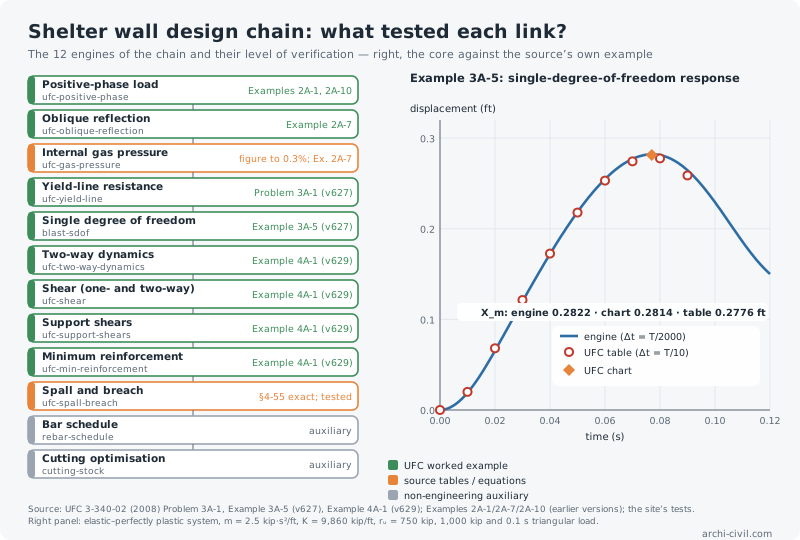
- Single-degree-of-freedom response — Example 3A-5. An elastic–perfectly plastic system under a triangular load. UFC gives two solutions: from design charts Xm = 0.2814 ft and tm = 0.077 s; from a coarse-step (Δt = T/10) numerical table about 0.2776 ft. The engine gives 0.2822 ft and 0.0771 s. The 1.4% difference between the source’s two solutions is not an error: re-running the same central-difference method with the same coarse step reproduced the table exactly; the fine-step engine converges to the chart solution.
3. Two more typesetting errors in the source
- In the table of Example 3A-5 the load at t = 0.06 s is printed as “40” kip; it should be 1000·(1 − 0.6) = 400 kip (the following rows are computed with 400).
- In Example 4A-12 the fragment penetration is printed as X′f = 12.8·(4000/5000)² (confirmed on a page rendering); but Eq. 4-202 itself has the exponent ½, and the example’s result (11.5 in) agrees with ½. With ² the result would be 8.2 in.
The list of source errors found in UFC 3-340-02 in this series has grown: the elastic modulus of glass (PRT-09), ground-shock Eqs. 2-76 and 2-83 (SIG-02), Table 5-1 and Eq. 5-3 (PRT-07) and these two. None affected the site’s engines; in every case the engines used the correct value.
4. A second round with Example 4A-1 (v629)
Most orange links were tested with Example 4A-1, which designs a two-way wall fixed on four edges from start to finish. Minimum reinforcement (0.00180 and 0.00120) and load-mass factors (0.65 / 0.66 / 0.67) matched exactly. The audit also produced six findings:
- A missing check in the chain. For two-way walls the diagonal-tension (shear) check was not performed at all; the step did not enter the list of checks, and sizing could propose a thickness whose shear had never been checked. For a 3.5 × 3.0 m wall exposed to 100 kg at 15 m, the old chain proposed 150 mm; the new chain finds no thickness adequate without shear reinforcement, and proposes 350 mm with Ø12/150 mm stirrups. The missing calculation (Table 4-7, Eqs. 4-23, 4-26, 4-31) was added and verified against Example 4A-1 (vuH 91.0, vuV 99.1, vcH 124.4, vcV 125.0 psi).
- Poisson’s ratio. The engine computed plate stiffness with E·I, justified by “UFC takes Poisson’s ratio as zero”; but UFC Eq. 3-33 defines D = EI/(1 − ν²) and the example uses ν = 0.167. Fixed (stiffness rises by 2.8%).
- Yield line: a chart reading. UFC reads the location from Figure 3-17 as x/L = 0.405 and finds ru = 24.13 psi; the engine solves equilibrium exactly: x = 73.7 in, ru = 23.63 psi. In yield-line theory a wrong location gives a higher (unsafe) resistance; the engine’s value is the right one.
- A chart-reading error. For four simply supported edges the example reads γ1 = 0.0054; the engine gives 0.0060. The independent referee is Timoshenko’s plate theory: about 0.0060 for an aspect ratio of 1.25. The example’s reading is wrong.
- A typesetting error. Step 22 prints the horizontal shear capacity as “122.4 psi”; it should be 1.9·√4000 + 2500·0.0017 = 124.4 psi, which step 23 uses.
- An inconsistency in the source. The body text gives Eq. 4-31 for diagonal bars as Ad = (Vs − Vd)/(fds·sinα); Example 4A-1 computes “minimum” diagonal bars as Ad = vc·b·d/(fds·sinα) and also labels it “Eq. 4-31”. That formula is not defined in the body. Consistent with the one-way case, the engine applies the body equation; the example’s value is shown for information.
The pages of Table 4-7 also carry the header “DRAFT UFC 3-340-02, 08 AUG 2008”; draft pages appear to have entered the official document. Two links remain open: internal gas pressure and spall (UFC has no worked example for blast-induced spall).
5. A hierarchy of verification
- The source’s worked example is the strongest test: the same result from the same inputs also verifies the method.
- The source’s tables and equations are the second level: they show each number is right, but not how they are used together.
- Internal consistency (dimensional analysis, equilibrium residuals) is the third level: it can catch errors but cannot prove correctness.
- A tool is as reliable as the level of its weakest link. That is why the figure shows each link’s level explicitly.
References
- U.S. DoD (2008). UFC 3-340-02 — Problem 3A-1 (doc pp. 991–997), Example 3A-5 (pp. 1019–1023), Example 4A-1 (pp. 1311–1321), Table 4-7 (pp. 1110–1111), Eq. 3-33 (p. 528), Eqs. 4-30/4-31; Example 4A-12 and Eq. 4-202 (pp. 1399, 1406).
- archi-civil.com engine/shelter-wall-workflow.js and linked engines (ufc-yield-line, blast-sdof and others) — tests/v627-sig03.test.js.
The numbers in this article were produced by the site's engines; code values are given with their clause numbers.