
Home / Articles / Shelters SIG-05
Source Research: Two of Four Gaps Closed
A typesetting error in the buried-burst engine found through physics, chamber gas pressure tested against real experiments, a new fallout-shielding engine based on a public-domain source; fire and spall remain open for lack of sources.
1. Four gaps, one research effort
SIG-04 ended with four open gaps: fire resistance of an RC wall, fallout shielding, two links of the chain (internal gas pressure and spall) and an audit of the buried-burst engine. Publicly accessible primary sources were researched for them. The outcome is uneven: two were closed with public-domain sources, one was tested against real test data, two remain open. This article explains what was done and what could not be done, with reasons.
2. Buried burst: a typesetting error and a check case
The site’s buried-burst engine is based on Drake and Little (1983), the work underlying TM 5-855-1, published on DTIC for public release. The engine applies the equations and soil table exactly and reproduces the research check case (100 lb, 20 ft, dense sand) in all four values: V0 = 4.15 ft/s, P0 = 183 psi, a0 ≈ 104 g, d0 ≈ 0.162 ft.
But the table itself has an error, and physics exposes it. Acoustic impedance ρc and wave speed c together give the soil density. All rows give plausible densities of 93–139 lb/ft³, while ρc = 48 in the saturated-soil row gives about 45 lb/ft³: lighter than water, which is impossible. The same paper’s Table I gives 125–130 for saturated soils. The engine now uses 130; the old value computed peak pressure in saturated soil about 2.7 times too low, i.e. on the unsafe side. The attenuation exponent for loose dry sand was also moved to the conservative end (3.0) of the source’s 3–3.25 range.
3. Explosion in a chamber: the engine above the measurements
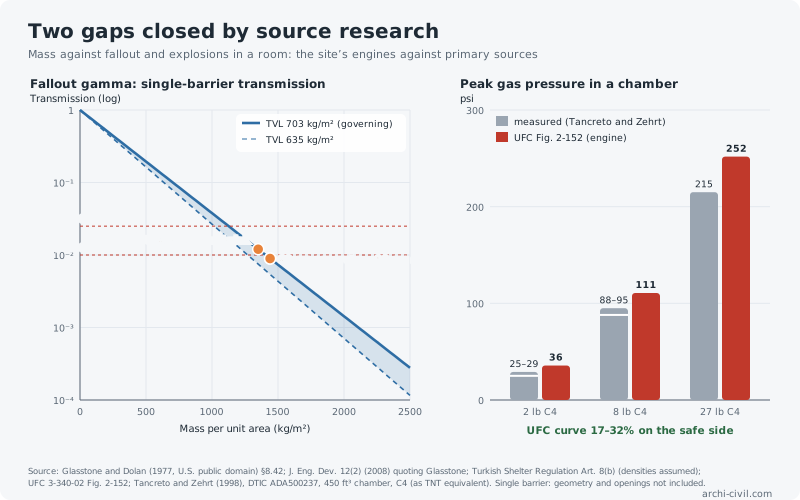
UFC 3-340-02 has no worked example for its peak gas pressure curve (Fig. 2-152). For an independent test, measurements by Tancreto and Zehrt (1998, DTIC ADA500237) in a 450 ft³ chamber were used. With TNT equivalence, the UFC curve predicts the measured pressure 17–32% high in every test group: on the safe side, because the curve ignores the pressure relief of venting. For test 9, where the paper gives its own method’s prediction as about 35 psi, the engine gives 35.7 psi.
4. Fallout: a new engine
Gamma shielding depends largely on mass per unit area; the tenth-value thickness times density is roughly constant. Glasstone and Dolan (1977, U.S. public domain) give about 130 lb/ft² (≈ 635 kg/m²) for fission-product gamma; a secondary source quoting that table gives 30.5 cm of concrete, i.e. ≈ 703 kg/m², for fallout gamma. The new engine computes both and uses the less favourable one.
Result: the three wall options of Turkey’s Shelter Regulation (60 cm concrete, 75 cm brick, 90 cm compacted soil) correspond with typical densities to 1,350–1,440 kg/m² and, as a single barrier, to an attenuation of about 83–112 times, clearly above the protection factor of 40 in the U.S. civil-defence definition of a fallout shelter. A real building’s protection factor also depends on geometry, openings and the roof; the engine does not cover these and says so.
5. What remains open, and why
- Fire resistance of an RC wall. The wall table of EN 1992-1-2 is copyrighted. Although its values appear in verified secondary publications, publishing them on the site requires purchasing EN 1992-1-2 (TS EN in Türkiye). The 2004 and 2023 editions also differ; the engine must state which it applies.
- Spall. The relevant UFC 3-340-02 clause (§4-55) has been changed twice, one change being rescinded for SI-unit errors, and its test basis is only partly public. The engine will not be audited until the current text and McVay (1988) are obtained.
References
- Drake, J. L. and Little, C. D. (1983). Ground Shock from Penetrating Conventional Weapons. U.S. Army WES; DTIC ADP001706 (public release).
- Tancreto, J. E. and Zehrt, W. H. (1998). Design for Internal Quasi-Static Pressures from Partially Confined Explosions. 28th DDESB Seminar; DTIC ADA500237 (public release).
- Glasstone, S. and Dolan, P. J. (1977). The Effects of Nuclear Weapons, 3rd ed. U.S. DoD/ERDA (public domain) — §8.42, Table 8.41, Table 9.120.
- J. Eng. Dev. 12(2) (2008), Table 1 (quoting Glasstone).
- archi-civil.com engine/ground-shock.js (v631), engine/fallout-shielding.js, engine/ufc-gas-pressure.js — tests/v631-sources.test.js, tests/fallout-shielding.test.js.
The numbers in this article were produced by the site's engines; code values are given with their clause numbers.